To apply for Canada study permit 2027, first secure admission from a designated learning institution, obtain a provincial attestation letter or Quebec Acceptance Certificate if required, and apply online with credible financial and identity documents. Canada’s study-permit intake controls are expected to continue in 2027, so applicants should start with their school well before the intake deadline.
What is confirmed for 2027 and what is not
As of November 3, 2026, Canada’s 2026–2028 Immigration Levels Plan sets a notional target of 150,000 new international student arrivals for 2027. This is not a promise that 150,000 study permits will be approved, nor is it the number of applications IRCC will accept. It is a planning target for new arrivals, and the government says 2027 temporary-resident targets may be confirmed or adjusted by November 1 of each year.
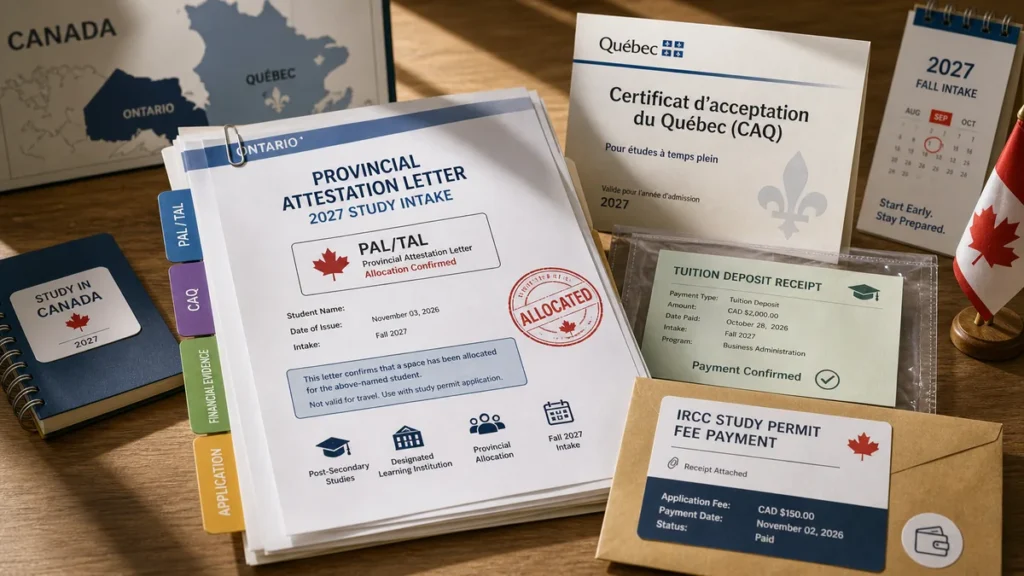
IRCC has also stated that its study-permit intake cap is intended to continue through 2027. In practice, many post-secondary applicants will need a provincial attestation letter (PAL) or territorial attestation letter (TAL), showing that they have received a space within their province or territory’s allocation. Provinces and territories decide how to distribute available spaces among designated learning institutions (DLIs).
For a 2027 application, do not assume that an offer of admission alone guarantees access to a PAL/TAL. Ask the school whether it has allocation space for your intended intake, whether a tuition deposit is required before it issues a PAL/TAL, and what its internal deadline is.
- Confirmed planning position: the federal Levels Plan lists 150,000 student arrivals for 2027.
- Likely continuing application control: most PAL/TAL-required post-secondary applicants remain subject to the allocation process.
- Not yet safely predictable: 2027 provincial allocations, school-level allocation availability, processing times and any financial-threshold increase effective September 1, 2027.
Check whether you need a Canada Study Permit 2027
You generally need a Canada study permit if your program in Canada lasts more than 6 months. A short program of 6 months or less may not require a study permit, but applying for one can be important if you expect to continue studying in Canada after the short program ends.
Most applicants apply before travelling to Canada. Applications are generally submitted online, whether you are outside Canada or already in Canada. Paper applications are limited to applicants who cannot apply online because of a disability or who hold an identity or travel document for non-national residents, refugees or stateless persons.
A study permit is not the same as a visitor visa or electronic travel authorization (eTA). If IRCC approves an overseas study-permit application, it normally issues the required temporary resident visa or eTA automatically, where applicable. You should not make a separate visa or eTA application for the same purpose.
- Choose a program that is longer than 6 months if you need a study permit for the full period of study.
- Confirm that the institution is a DLI before paying deposits or submitting an application.
- If working in Canada after graduation is part of your plan, check the exact program’s post-graduation work permit eligibility before applying.
Choose the school and program carefully
Your letter of acceptance (LOA) must come from a designated learning institution. At the post-secondary level, IRCC maintains a DLI list that also identifies institutions and programs that may be eligible for the post-graduation work permit (PGWP). A school being a DLI does not mean every program at that school qualifies for a PGWP.
This distinction matters because PGWP eligibility can depend on the institution, the particular program, its length, the way it is delivered and, for some programs, language and field-of-study requirements.
Applicants who submit a study-permit application on or after November 1, 2024 may face PGWP field-of-study requirements where those rules apply. A future work permit or permanent residence outcome should never be assumed simply because a student obtains a study permit.
For a study-permit application, the LOA should identify the program, expected start and end dates, registration deadline and tuition amount. Post-secondary DLIs must validate the LOA through IRCC’s verification process. If the institution does not validate it by IRCC’s deadline, the application can be returned and the processing fee refunded.
- Use IRCC’s DLI list to verify the school, campus and DLI number.
- Check whether your exact program, rather than just the institution, is PGWP-eligible.
- Keep written records of tuition payments, deposit conditions and the school’s PAL/TAL process.
Get a PAL, TAL or CAQ if required
Most post-secondary applicants need a PAL or TAL before filing a study-permit application. Your school is normally the starting point: in many cases, you must accept the offer and pay some or all tuition before the school can request or issue the attestation through the provincial or territorial system.
Students planning to study in Quebec usually need a Quebec Acceptance Certificate (CAQ). For study-permit purposes, the CAQ serves as Quebec’s attestation document. Quebec has separate provincial requirements, including its own financial assessment, so applicants should follow both Quebec and federal instructions.
Some applicants are exempt from the PAL/TAL requirement. Since January 1, 2026, students entering a degree-granting master’s or doctoral program at a public DLI do not need a PAL/TAL.
Other exemptions can apply, including for primary and secondary school students, certain exchange students, Global Affairs Canada scholarship recipients and certain applicants already in Canada. An exempt applicant should provide evidence of the exemption with the application rather than simply leaving the requirement unexplained.
- Do not submit a PAL/TAL-required application without the required attestation unless you clearly qualify for an exemption.
- For Quebec, obtain and upload the valid CAQ in the relevant PAL/TAL and CAQ document fields.
- A PAL/TAL is evidence of an allocation space; it does not by itself establish that you meet all study-permit requirements.
Prepare evidence of funds and a credible study plan
You must show that you can pay tuition, living expenses and transportation to and from Canada without relying on work in Canada. For programs lasting more than one year, IRCC expects proof that you can fund the first year and an explanation of how you will pay for the full duration of the program.
For applications made on or after September 1, 2026, the published minimum living-expense amount outside Quebec is CAD $23,448 for one family member, excluding tuition and transportation. The amount rises with each accompanying family member. Because IRCC adjusts this requirement annually on September 1, applicants for September 2027 or later should verify the updated amount before filing.
Bank statements alone may be insufficient if they do not show where the money came from. Strong evidence connects the available funds to their source, such as employment income, long-term savings, an education loan, scholarship documents, business records or a sponsor’s verifiable income and relationship to the student. A sudden unexplained deposit can undermine the application.
IRCC recommends a letter of explanation. Use it to explain why the program makes academic and career sense, why it is appropriate given your previous education or work history, how it will be funded and that you understand your responsibility to leave Canada when your authorized stay ends. The letter should match the rest of the evidence; it should not make unsupported claims about guaranteed employment, permanent residence or immigration outcomes.
- Include tuition evidence, living-expense evidence and a realistic return-transportation budget.
- Provide six months of bank statements where relevant, along with documents showing the source of the funds.
- If another person supports you, document the relationship, the promised amount and the supporter’s capacity to provide it.
- Arrange certified translations for documents that are not in English or French, following IRCC’s translation rules.
| 1 | CAD $23,448 |
| 2 | CAD $29,192 |
| 3 | CAD $35,888 |
| 4 | CAD $43,572 |
| Each additional family member above 7 | CAD $6,318 |
More information: Proof of Funds for a Canada Study Permit
Submit the online study-permit application
After collecting your documents, use the IRCC online application process. The online questionnaire creates a personalized document checklist based on your circumstances and country or territory of application. Follow any local visa-office instructions as well, since IRCC may require country-specific documents.
Core documents usually include a valid passport or travel document, digital photo, LOA, PAL/TAL or CAQ where required, proof of funds and a letter of explanation. Depending on your circumstances, IRCC may also require biometrics, a medical examination, police certificate, proof of legal status in your current country of residence or documents for accompanying family members.
The study-permit processing fee is CAD $150 per person. Biometrics, when required, cost CAD $85 per person, subject to the family maximum. Applicants aged 14 to 79 usually need biometrics if they have not provided valid biometrics in the previous 10 years. Pay the biometrics fee when submitting the application to avoid delay.
Use our IRCC fee calculator.
After submission, IRCC may issue a biometrics instruction letter, request more documents, ask for a medical exam or schedule an interview. If approved from outside Canada, you normally receive a port-of-entry letter of introduction. The final study permit is issued by the border services officer when you arrive in Canada, provided you remain admissible and still meet the conditions of entry.
- Apply online early enough to complete biometrics, medical exams and any follow-up request before your program begins.
- Use the document-upload field assigned to each item; only place the LOA in the LOA-specific field.
- Save copies of every form, receipt, upload and message from IRCC.
- Do not book non-refundable travel solely because you have submitted an application.
A practical 2027 application sequence
For a 2027 intake, the safest sequence is to begin with the school rather than the IRCC application portal. Admission, PAL/TAL access and supporting documents take time, and a complete application is more useful than an early but poorly supported filing.
Processing times differ by country and can change. Use IRCC’s processing-time tool only as a planning estimate, not as a deadline guarantee. Doctoral students may qualify for IRCC’s faster two-week processing initiative, but this does not remove the need to submit a complete application or meet eligibility and admissibility requirements.
- 1. Confirm that the school is a DLI and review the exact program’s PGWP status if relevant.
- 2. Apply to the school and obtain a detailed LOA.
- 3. Ask the school about PAL/TAL availability, deposit requirements and its deadline; obtain a CAQ first if studying in Quebec.
- 4. Build financial evidence that covers tuition, living costs and transportation, with clear source-of-funds records.
- 5. Prepare identity documents, translations, a study-plan letter and any country-specific documents.
- 6. Submit the online application, pay the CAD $150 study-permit fee and pay biometrics fees if applicable.
- 7. Complete biometrics and promptly respond to any IRCC request for a medical exam, interview or additional evidence.
Source: Study permit: Who can apply
Disclaimer
Maplevisa provides Canadian immigration news and information for general informational purposes only. Content is not legal or immigration advice and should not be relied upon as a substitute for advice based on your individual circumstances. Immigration laws, policies, programs, and procedures may change. Where applicable, readers should consult the relevant official government or legal source for current information.
More Immigration News
CRS Points Express Entry: November 3 Changes
Haiti Open Work Permit Renewals Policy
Sudan Open Work Permit Renewal Policy in Canada

Canada Immigration Processing Times on 1 November 2026
BC PNP Skills Draw Issues 772 ITAs on October 29, 2026

IRCC Changes LMIA Concurrent Processing
Express Entry Draw 453 Transport on October 28, 2026
Express Entry Draw 452 French-Language on October 27, 2026
Express Entry Draw 451 PNP on October 26, 2026