As of November 25, 2026, Canada identifies five permanent-residence routes for internationally trained medical doctors for Canadians: Express Entry, the Provincial Nominee Program, the Atlantic Immigration Program, the Rural Community Immigration Pilot and the Francophone Community Immigration Pilot. However, the Rural Community Immigration Pilot closes on January 1, 2027, with a permanent rural program set to replace it.

Medical doctors for Canadians: five routes at a glance
Canada is seeking to strengthen health care for Canadians by making permanent residence more accessible to qualified international medical doctors. The right option depends mainly on whether the physician already has Canadian work experience, a job offer, a provincial connection, French-language ability or an intended destination in a participating community.
These are immigration pathways, not automatic authorization to practise medicine. A doctor must separately meet the credential-recognition and licensing rules of the province or territory where they plan to work.
| Express Entry | Physicians who qualify for a federal Express Entry program, including doctors with Canadian or foreign work experience | Physicians may be eligible for healthcare and social services rounds, while a separate physicians category is available for qualifying Canadian work experience. |
| Provincial Nominee Program | Doctors with a job, job offer or provincial or territorial letter of support | Provinces and territories have up to 5,000 federal immigration spaces reserved for nominations of eligible medical doctors. |
| Atlantic Immigration Program | Doctors with a designated-employer job offer who want to settle in Atlantic Canada | Requires a valid offer from a designated employer and other program requirements, including language ability and a settlement plan. |
| Rural Community Immigration Pilot | Doctors with a designated-employer offer and community recommendation in a participating rural community | The pilot closes January 1, 2027. New applicants without a recommendation under the pilot should assess the incoming permanent Rural Community Immigration Program. |
| Francophone Community Immigration Pilot | French-speaking doctors with a designated-employer job offer in a participating Francophone community outside Quebec | Requires French ability at a minimum NCLC 5 in all four language skills, as well as the program’s work, education and settlement requirements. |
Permanent residence does not licence a doctor to practise
For internationally trained physicians, immigration and professional licensing are connected but separate processes. Before working as a physician, applicants must have their foreign credentials assessed and become licensed through the relevant provincial or territorial medical regulatory authority.
The requirements can vary by jurisdiction and may involve document verification, examinations, postgraduate training assessments or other steps set by the regulator. Applicants should identify the province or territory where they intend to practise before beginning the licensing process, because the local regulator determines the applicable standards.
This distinction matters in every pathway. A permanent-residence application can support a long-term plan to live in Canada, but it does not replace the medical licence required to use the title of doctor or provide regulated medical services.
- Use the federal Foreign Credential Recognition Tool to identify whether the occupation is regulated in the intended province or territory and to find the appropriate regulator.
- Start credential recognition early. The federal government notes that assessment and licensing can take time.
- Keep immigration evidence and licensing evidence organized separately, since work experience, job offers, language tests and licensing documents may be evaluated by different organizations.
Express Entry for physicians
Express Entry is a federal system that manages applications under the Federal Skilled Worker Program, Canadian Experience Class and Federal Skilled Trades Program. A physician must first be eligible for one of these programs before category-based selection can be relevant.
Medical doctors can potentially benefit from two different Express Entry category approaches. The healthcare and social services occupations category includes specialists in clinical and laboratory medicine, specialists in surgery, and general practitioners and family physicians. It requires at least 12 months of qualifying full-time work experience, or an equivalent amount of part-time experience, within the previous three years; that experience may have been gained in Canada or abroad.
Canada also has a separate category for physicians with Canadian work experience. To qualify for that category, a candidate must have at least 12 months of full-time, or equivalent part-time, Canadian work experience during the previous three years in one of the three physician occupations.
Meeting the occupation requirement does not guarantee an invitation. Candidates must be in the Express Entry pool, meet the rules for the round, and rank high enough under the Comprehensive Ranking System when IRCC holds a relevant round.
- NOC 31100: Specialists in clinical and laboratory medicine.
- NOC 31101: Specialists in surgery.
- NOC 31102: General practitioners and family physicians.
- A job offer is not necessarily required for Express Entry, but it may be essential for other pathways or for securing a position while licensing is underway.
Provincial Nominee Program for medical doctors
The Provincial Nominee Program is especially important for physicians who have a job, job offer or letter of support to work in a Canadian province or territory. Each jurisdiction operates its own streams and decides whom it will nominate, so the applicable criteria depend on the destination and the available stream.
IRCC states that provinces and territories have up to 5,000 federal immigration spaces reserved to nominate medical doctors with qualifying job offers or letters of support. This is a federal allocation measure, not a guarantee that every eligible physician will receive a nomination.
After receiving a provincial or territorial nomination, the physician applies to IRCC for permanent residence. The PNP has Express Entry-aligned and non-Express Entry application processes, depending on the nomination stream.
Eligible nominated doctors in three specified physician NOC occupations may also qualify for 14-day processing of a work permit application. This faster processing relates to the work permit application and should not be treated as a guarantee of permanent-residence approval.
- For faster work permit processing, the application must be online and supported by a full-time, non-seasonal job offer in NOC 31100, 31101 or 31102.
- The applicant needs a provincial or territorial support letter confirming nomination as a permanent-residence applicant.
- The employer must provide required employment documentation, including the offer of employment number and the applicable labour-market-impact-assessment exemption code.
- An upfront immigration medical examination is required for this expedited work permit process.
Atlantic, rural and Francophone community routes
The Atlantic Immigration Program may suit doctors who want to live in New Brunswick, Newfoundland and Labrador, Nova Scotia or Prince Edward Island. Applicants need a valid job offer from a designated employer and must meet the program’s work experience, education, language, settlement-plan and, where applicable, proof-of-funds requirements.
The Rural Community Immigration Pilot is still listed among the five physician pathways, but its timing is crucial. IRCC states that the pilot closes on January 1, 2027. A person with a community recommendation dated December 31, 2026 or earlier can apply for permanent residence before that recommendation expires; a person without such a recommendation should instead explore the permanent Rural Community Immigration Program, which opens January 1, 2027.
Under the closing rural pilot, applicants generally need a valid offer from a designated employer, a recommendation certificate from the participating community, qualifying work experience, language test results, education and settlement funds. For a physician job offer in TEER 1, the minimum language requirement is Canadian Language Benchmark 6 in English or French.
The Francophone Community Immigration Pilot is for applicants who intend to live in a participating Francophone community outside Quebec. It requires a valid job offer from a designated employer, qualifying related work experience or a qualifying graduate exemption, education, proof of funds and French-language results.
For the Francophone pilot, applicants must demonstrate at least NCLC 5 in reading, writing, listening and speaking. This makes the program a distinct option for physicians who can work and settle in French outside Quebec, rather than simply an alternative version of Express Entry.
- Atlantic Immigration Program: choose this route when a designated employer in Atlantic Canada offers an eligible physician position.
- Rural route: verify whether the community and employer are participating, and distinguish the closing pilot from the permanent program opening on January 1, 2027.
- Francophone route: confirm the employer and community are designated, then plan for an approved French test showing at least NCLC 5 in all four abilities.
- For both community pilots, international graduates of eligible public post-secondary institutions in the recommending community may be exempt from the work-experience requirement if they meet the detailed study, timing and residence conditions.
How physicians can choose the most relevant route
A physician with at least one year of recent Canadian medical work experience should assess Express Entry first, particularly the physicians with Canadian work experience category. They should also consider a provincial nomination if they have an employer or provincial support.
A doctor outside Canada without Canadian physician experience may have several viable routes. Express Entry can still be relevant if the candidate meets a federal program’s baseline criteria and has qualifying medical work experience. The healthcare and social services category accepts qualifying experience gained abroad as well as in Canada.
A physician with a concrete employment opportunity should compare the PNP, Atlantic Immigration Program and community-based programs according to the employer’s location and designation status. The existence of a job offer does not by itself establish eligibility; the employer, occupation, applicant and destination must all fit the chosen program’s rules.
French-speaking physicians should consider both the Francophone Community Immigration Pilot and Express Entry’s French-language category where they meet the relevant criteria. These are separate selection mechanisms with different eligibility rules.
- Canadian physician experience: assess Express Entry’s physicians category and provincial nomination options.
- Provincial job offer or support letter: assess the Provincial Nominee Program and whether expedited work permit processing is available.
- Atlantic designated-employer offer: assess the Atlantic Immigration Program.
- Rural designated-employer opportunity: check the transition from the Rural Community Immigration Pilot to the Rural Community Immigration Program on January 1, 2027.
- French-language ability and a job offer outside Quebec: assess the Francophone Community Immigration Pilot.
What applicants should verify before applying
Doctors should not assume that a broad labour need removes normal immigration and licensing requirements. A strong application requires the correct occupation code, credible evidence of qualifying work history, valid language test results, education documents, any required credential assessment and pathway-specific job-offer or community documents.
Where a work permit is needed before permanent residence is finalized, applicants should confirm whether the available work permit route matches their nomination, job offer and licensing status. Working as a physician without the required provincial or territorial authorization is not an alternative to completing professional licensing.
Because program criteria, participating employers, provincial streams and invitation rounds can change, applicants should verify the current rules directly with IRCC, the relevant province or territory, the participating community and the medical regulator before filing an application.
- Confirm the physician NOC code with the employer and ensure the duties match the occupation claimed.
- Check whether the target employer is designated where a designated-employer program is being used.
- Confirm that language-test results will still be valid on the application date.
- Verify the medical regulator’s credential-recognition and licensing process in the intended province or territory.
- Treat an invitation, nomination or work permit as a separate step from obtaining a licence to practise medicine.
Maplevisa provides Canadian immigration news and information for general informational purposes only. Content is not legal or immigration advice and should not be relied upon as a substitute for advice based on your individual circumstances. Immigration laws, policies, programs, and procedures may change. Where applicable, readers should consult the relevant official government or legal source for current information.
Disclaimer
Maplevisa provides Canadian immigration news and information for general informational purposes only. Content does not constitute legal or immigration advice and should not be relied upon as a substitute for advice based on individual circumstances. Immigration laws, regulations, policies, programs, and procedures may change. Readers should consult relevant official government sources, legislation, or court decisions, as appropriate, to verify current information.
More Immigration News
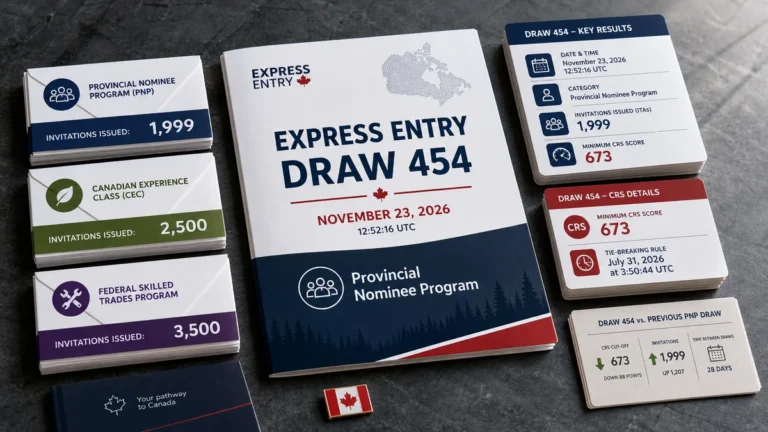
Express Entry Draw 454 PNP on November 23, 2026
Immigration medical exam exemption in Canada

Canada Immigration Processing Times on 20 November 2026
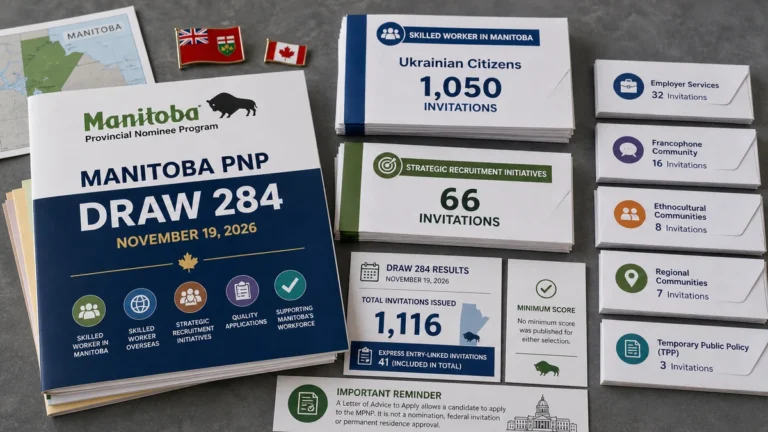
Manitoba PNP draw 284 selects 1,116 on November 19, 2026
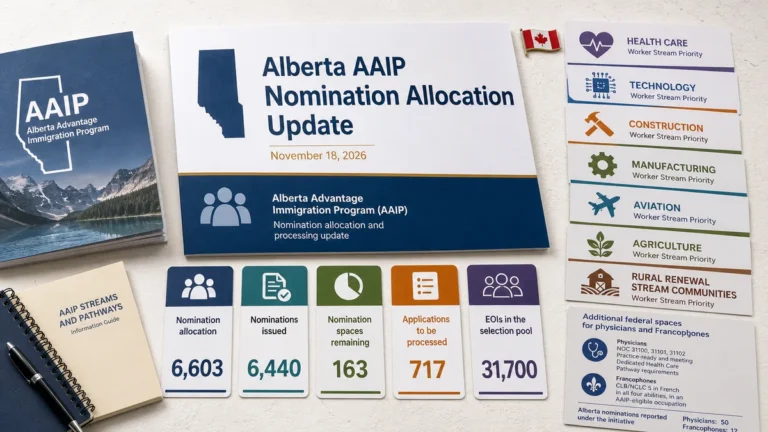
Alberta AAIP Issues 374 Invitations in 3 Rounds
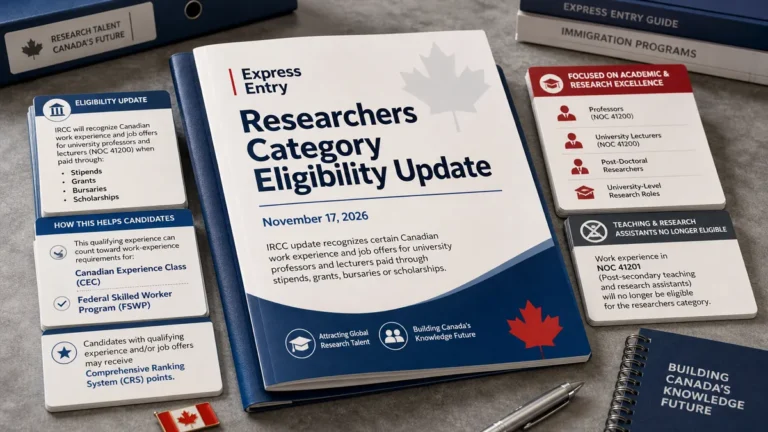
Express Entry researchers category eligibility updated
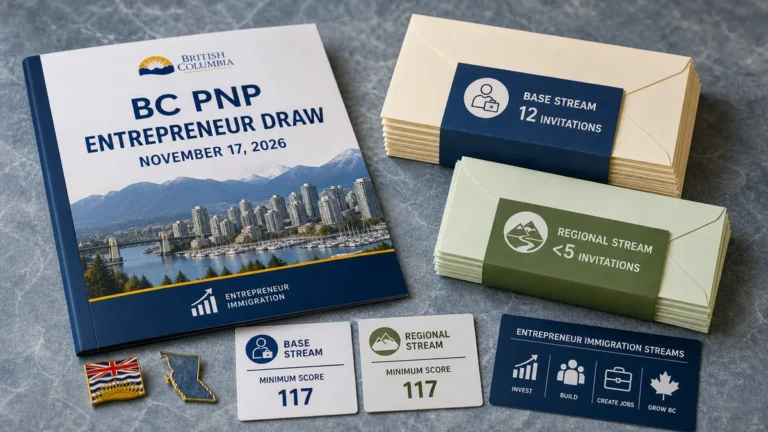
BC PNP Entrepreneur Draw, November 17, 2026
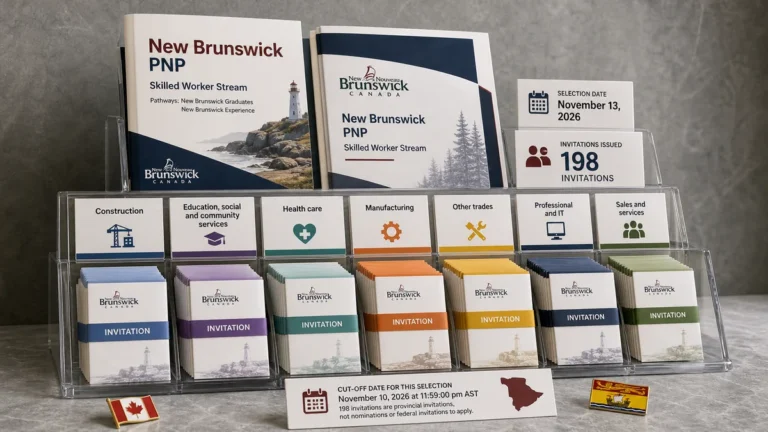
New Brunswick Reports 390 PNP Invitations and 73 AIP Selections
Newfoundland and Labrador Issues 54 NLPNP & AIP Invitations