Visitor visa processing times:
These historical figures describe processing of completed applications; they are not an individual prediction for your case.
Comparison with the report dated November 10, 2026
These 10 high-volume countries follow the largest source-country totals for V-1 visitor visas approved in IRCC’s 2025 operational data. This is a high-volume proxy, not a ranking of new applications received. Processing estimates below use the country selected in IRCC’s tool, rather than an applicant’s citizenship.
For eligibility and supporting documents, see our visitor visa guide.
| Country | Current | Previous | Change |
|---|---|---|---|
| India | 31 days | 32 days | −1 day |
| China | 49 days | 51 days | −2 days |
| Nigeria | 98 days | 103 days | −5 days |
| Colombia | 15 days | 15 days | unchanged |
| Mexico | 15 days | 14 days | +1 day |
| Ukraine | 28 days | 28 days | unchanged |
| Jamaica | 43 days | 41 days | +2 days |
| Pakistan | 46 days | 58 days | −12 days |
| Philippines | 23 days | 24 days | −1 day |
| Vietnam | 37 days | 39 days | −2 days |
Study permit processing times:
These historical figures describe processing of completed applications; they are not an individual prediction for your case.
These 10 high-volume countries follow the largest source-country totals for new study permit applications processed, including approvals, refusals and withdrawals in IRCC’s 2025 operational data. This is a high-volume proxy, not a ranking of new applications received. Processing estimates below use the country selected in IRCC’s tool, rather than an applicant’s citizenship.
See our study permit guide for application requirements and our explanation of study permit processing times.
| Country | Current | Previous | Change |
|---|---|---|---|
| India | 7 weeks | 8 weeks | −1 week |
| Nigeria | 11 weeks | 11 weeks | unchanged |
| China | 12 weeks | 12 weeks | unchanged |
| Guinea | 4 weeks | 6 weeks | −2 weeks |
| Senegal | 4 weeks | 7 weeks | −3 weeks |
| France | 2 weeks | 3 weeks | −1 week |
| Philippines | 5 weeks | 6 weeks | −1 week |
| Cameroon | 12 weeks | 9 weeks | +3 weeks |
| Algeria | 6 weeks | 8 weeks | −2 weeks |
| Ghana | 15 weeks | 14 weeks | +1 week |
Super visas and work permits outside Canada
Processing times for these applications vary by the country you apply from. Use the processing-times tool below to check the estimate for your application.
- Super visa: Select Super visa and your country of application in the processing-times tool. See our visitor visa guide for related visitor information.
- Work permit from outside Canada: Select your country of application in the processing-times tool. See our work permit guide for application requirements.
Inside Canada and PR cards
These historical figures describe processing of completed applications; they are not an individual prediction for your case.
| Application | Current | Previous | Change |
|---|---|---|---|
| Visitor visa inside Canada | 12 days | 12 days | unchanged |
| Visitor record extension | 296 days | 310 days | −14 days |
| Study permit extension | 52 days | 53 days | −1 day |
| Work permit extension | 119 days | 120 days | −1 day |
| First permanent resident card | 32 days | 29 days | +3 days |
| Renewal or replacement of PR card | 50 days | 46 days | +4 days |
Permanent residence, sponsorship and citizenship:
These estimates concern a new application; they are not the remaining wait for an application already submitted.
| Application | Current | Previous | Change |
|---|---|---|---|
| Canadian Experience Class (CEC) | 6 months | About 6 months | not directly comparable; scope, method or unit differs |
| Federal Skilled Worker Program (FSW) | About 9 months | About 7 months | approximately +2 months |
| Provincial nominees through Express Entry | About 7 months | About 7 months | unchanged |
| Provincial nominees outside Express Entry | About 12 months | About 13 months | approximately −1 month |
| Spouse sponsorship inside Canada, outside Quebec | About 27 months | About 26 months | approximately +1 month |
| Spouse sponsorship inside Canada, Quebec | About 33 months | About 32 months | approximately +1 month |
| Spouse sponsorship outside Canada, outside Quebec | About 19 months | About 18 months | approximately +1 month |
| Spouse sponsorship outside Canada, Quebec | About 34 months | About 33 months | approximately +1 month |
| Citizenship grant | About 12 months | About 12 months | unchanged |
| Citizenship certificate | About 35 months | About 34 months | approximately +1 month |
Permit extensions:
These estimates concern a new application; they are not the remaining wait for an application already submitted.
For work permit extensions, the historical figure is 119 days, while the new-application estimate is 13 weeks. For study permit extensions, the historical figure is 52 days, while the new-application estimate is 8 weeks. These are different measures for completed cases and new applications at the time of the estimate; converting units does not make them a like-for-like trend comparison or a remaining-wait prediction.
| Application | Current | Previous | Change |
|---|---|---|---|
| Study permit extension, new application estimate | 8 weeks | 6 weeks | +2 weeks |
| Work permit extension, new application estimate | 13 weeks | 10 weeks | +3 weeks |
How IRCC calculates processing times
Historical processing times indicate how long it took to finalize 80% of complete applications in a past cohort; they are not an arithmetic average, and about 20% of that cohort took longer. These figures are generally updated weekly; see IRCC’s calculation guidance.
Forward-looking estimates project the time for a new application using pending inventory and expected processing capacity; annual admission levels also affect admission-limited programs. Update frequency depends on the application type: the monthly forward-looking series and the weekly permit-extension series in this report are separate measures.
What these figures mean for applicants
A change in a published estimate does not establish a change in your own application status, a decision or the cause of a delay. Application volumes, processing capacity and case-specific circumstances can affect the time needed.
Inventory includes all pending applications, not only cases beyond a service standard. IRCC service standards are targets under normal circumstances, not individual estimates, maximum waiting times or guaranteed decision dates; not every program has one.
IRCC counts from submission of a complete application, including required fees, online or in person, or its arrival in the mailroom for paper applications, until a decision. The tool includes time to give biometrics in the applicable estimates; respond to document or biometric requests by the stated deadline.
Exceeding a historical figure alone does not establish a problem with an application: some cases in that past cohort took longer. Check your account and, if your application is beyond the normal processing time, use the IRCC Web Form to ask about it; submitting a web form does not itself speed up processing.
Check the estimate for your application
Check current IRCC processing times with the Maplevisa tool
Select your application type and, where required, the country you are applying from to check the current estimate.
Official source: IRCC: Check current processing times
Maplevisa provides Canadian immigration news and information for general informational purposes only. Content is not legal or immigration advice and should not be relied upon as a substitute for advice based on your individual circumstances. Immigration laws, policies, programs, and procedures may change. Where applicable, readers should consult the relevant official government or legal source for current information.
Disclaimer
Maplevisa provides Canadian immigration news and information for general informational purposes only. Content does not constitute legal or immigration advice and should not be relied upon as a substitute for advice based on individual circumstances. Immigration laws, regulations, policies, programs, and procedures may change. Readers should consult relevant official government sources, legislation, or court decisions, as appropriate, to verify current information.
More Immigration News
Manitoba PNP draw 284 selects 1,116 on November 19, 2026
Alberta AAIP Issues 374 Invitations in 3 Rounds
Express Entry researchers category eligibility updated
BC PNP Entrepreneur Draw, November 17, 2026
New Brunswick Reports 390 PNP Invitations and 73 AIP Selections
Newfoundland and Labrador Issues 54 NLPNP & AIP Invitations
Nova Scotia EOI Selections Reach 1,296 in October 2026
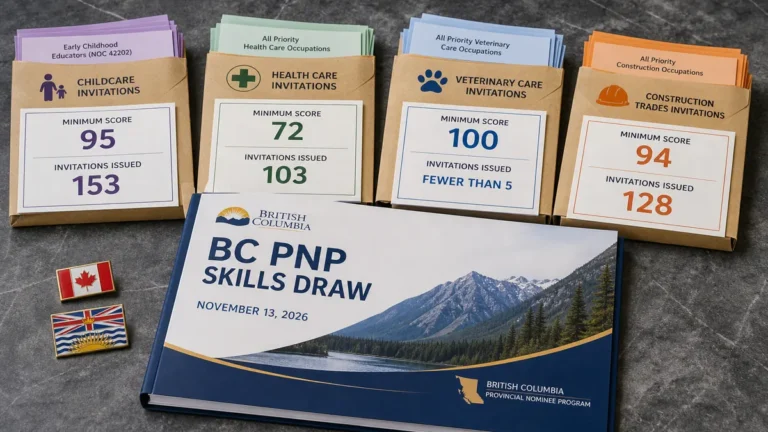
BC PNP Draw November 13, 2026: 384+ Invitations Issued
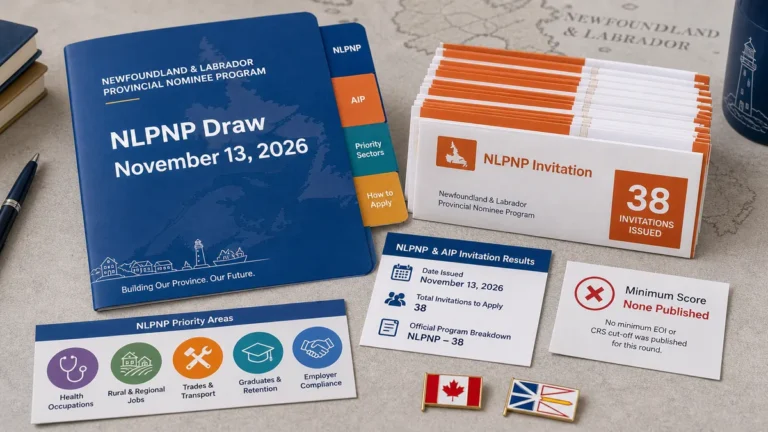
Newfoundland and Labrador Issues 38 NLPNP & AIP Invitations