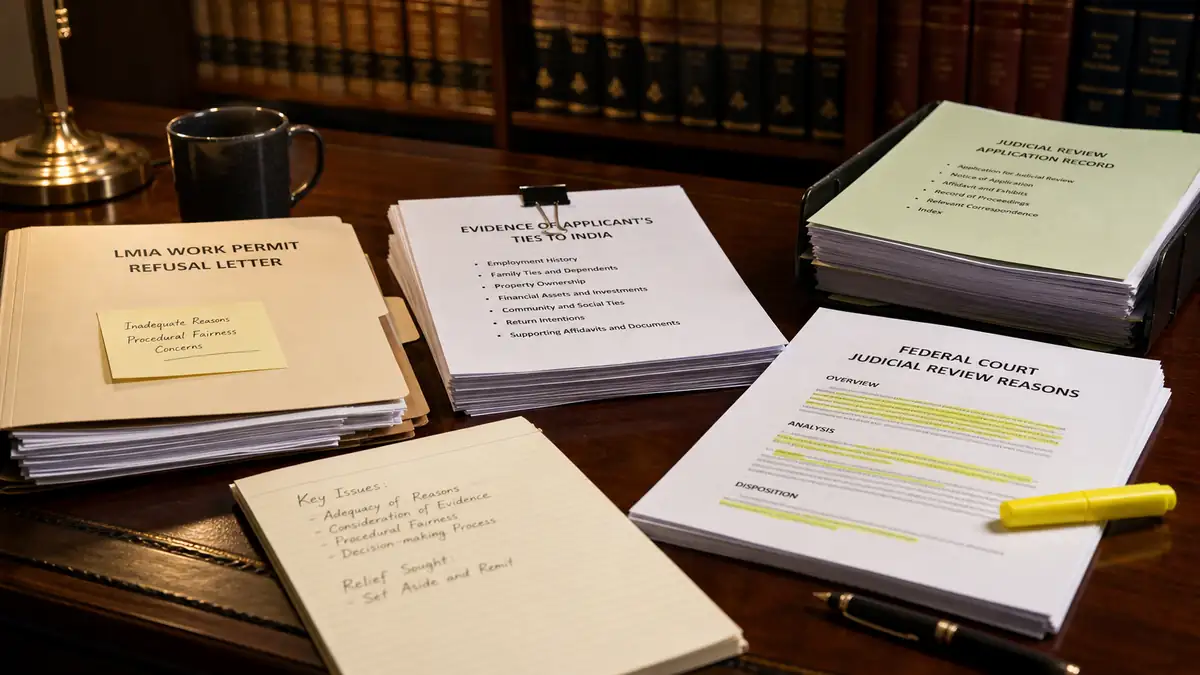

In an LMIA work permit decision released October 2, 2026, the Federal Court granted judicial review of the refusal of an Indian farm worker’s application. Justice Blackhawk found that the officer’s reasons did not meaningfully address evidence of the applicant’s ties to India and ordered reconsideration by a different officer.
Work permit refusal and evidence submitted
The applicant, a 56-year-old citizen of India who had worked in agriculture since 2000, applied on June 18, 2024, for an LMIA-based work permit to work as a general farm worker for Abby Valley Holding Ltd. in Abbotsford, British Columbia.
His application included evidence of education and qualifications, proof of funds, and documents concerning his socio-economic ties to India. Those documents included a marriage certificate, identity cards for his spouse and children, and evidence of property ownership.
An officer refused the application on February 24, 2025. The GCMS notes raised concerns that the purpose of the proposed visit was not consistent with a temporary stay and that the applicant could have economic motives to remain in Canada.
Parties disputed whether the reasons addressed the record
The applicant argued that the refusal was unreasonable because the officer had not grappled with the totality of the evidence filed in support of the application.
The respondent maintained that the officer was not satisfied the applicant would leave Canada at the end of his authorized stay and that the GCMS notes gave sufficient reasons. The respondent also pointed to an absence of evidence concerning the applicant’s catering business, the status of leased agricultural land in India, and how his farming operations would be managed during his time in Canada.
Justice Blackhawk found that these points were an attempt to bolster the officer’s reasons. The issues raised by the respondent in oral argument were not referenced in the GCMS notes.
Court found no meaningful engagement with key evidence
The parties agreed that reasonableness was the applicable standard of review. The Court considered whether the reasons were transparent, intelligible and justified in light of the facts and law constraining the officer.
The Court held that the officer had stated conclusions without analyzing the evidence that could have supported a different result. In particular, the reasons did not meaningfully grapple with contradictory evidence showing the applicant’s significant ties to India.
Justice Blackhawk rejected the suggestion that an economic incentive to work in Canada supported an inference that the applicant would overstay. The Court stated that the GCMS notes did not explain why the proposed visit was inconsistent with a temporary stay or what economic incentives would motivate the applicant to remain in Canada.
The Court concluded that the reasons were neither intelligible nor responsive to the evidence submitted, and did not provide enough clarity to show how the officer reached the decision.
Refusal set aside for reconsideration
The Federal Court granted the application for judicial review and remitted the work permit application for reconsideration by a different officer. There was no order as to costs, and no question was certified.
The decision concerns the adequacy of the reasons in this application. It does not direct that the work permit be approved; the application must instead be reconsidered.
Source: Federal Court Decisions