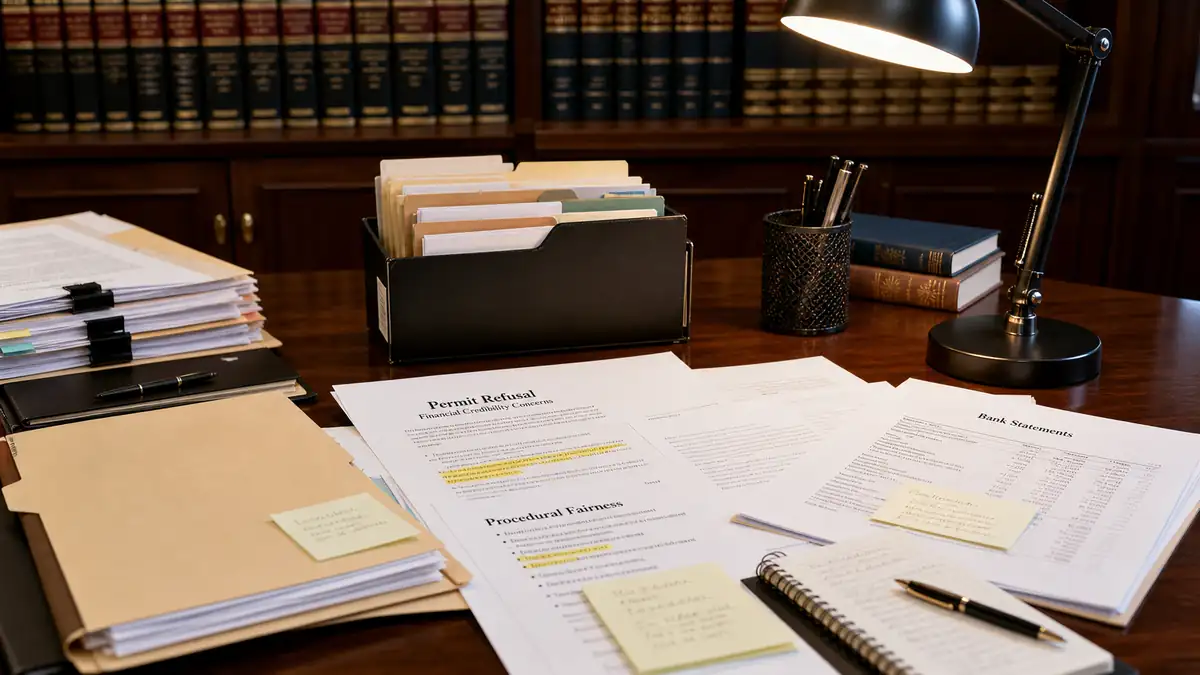

In Financial Credibility, the Federal Court granted judicial review after finding that a visa officer made an adverse credibility finding about the applicants’ bank balance without giving them an opportunity to respond. The decision concerned a spousal open work permit application and a study permit application. Justice Battista set aside the refusals and ordered redetermination by a different officer.
Officer refused applications over financial evidence
The applicants were the spouse and child of a foreign worker in Canada. They had applied for a spousal open work permit and a study permit.
A visa officer refused the applications on the basis that the applicants had not shown sufficient funds to support their proposed stay in Canada. The applicants sought judicial review, arguing that the officer had made a credibility finding without sending a procedural fairness letter.
Court found the concern went beyond insufficient funds
The respondent submitted that the officer’s decision concerned insufficient evidence, rather than adverse credibility, and therefore did not require an opportunity for the applicants to respond.
Justice Battista disagreed. The officer’s Global Case Management System notes stated that a significant change in the bank balance suggested the account had been inflated to obtain a visa and was for demonstration purposes only. The Court found that this was speculation that the applicants had fabricated bank transactions to support their applications.
The Court held that the comments expressed an adverse view of the applicants’ honesty and the reliability of information in their documents. It was not merely a concern about whether the financial evidence was sufficient.
Refusals set aside for procedural unfairness
The Court cited Fard v Canada (Citizenship and Immigration), 2024 FC 1403, for the principle that an applicant must have a chance to respond where an officer believes documentary evidence misrepresents a material fact.
Because the applicants were not given an opportunity to address the officer’s credibility concerns, the Court found that procedural fairness had been breached. The application for judicial review was granted.
The refusals were set aside and the matter was returned for redetermination by a different officer. The Court certified no question and made no order as to costs.
What the decision addresses
This decision turns on the distinction between an officer finding that financial evidence is inadequate and an officer suggesting that evidence was inflated or fabricated. In this case, the latter finding engaged procedural fairness because it concerned the applicants’ credibility.
Source: Federal Court Decisions