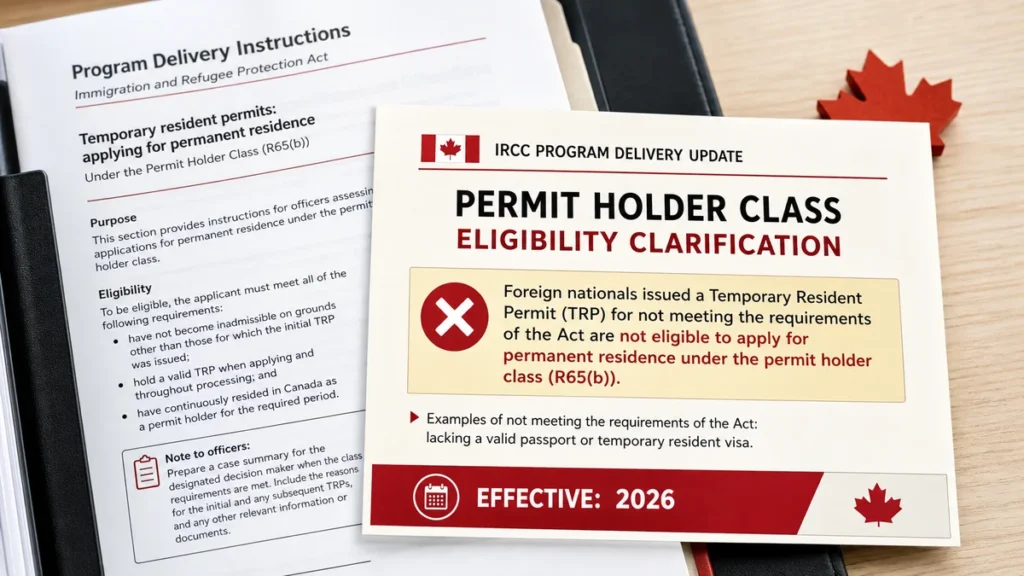
IRCC has updated its permit holder class eligibility instructions to clarify that foreign nationals issued a temporary resident permit (TRP) for not meeting the requirements of the Act cannot apply for permanent residence through this class. The update concerns TRPs issued for reasons such as lacking a valid passport or temporary resident visa.
What IRCC changed
The IRCC Program Delivery Updates notice says the instructions for “Temporary resident permits: applying for permanent residence” were updated with modernized language and a clarification on eligibility.
The clarification states that TRP holders whose permits were issued because they did not meet the requirements of the Act are not eligible for the permit holder class under R65(b). The instructions give a lack of a valid passport or temporary resident visa as examples of not meeting those requirements.
This is an operational clarification for officers and stakeholders assessing whether the reason a TRP was issued supports a permanent residence application in the permit holder class.
Current requirements for the permit holder class
The linked current Program Delivery Instructions state that a TRP holder may apply for permanent residence in the permit holder class if they have not become inadmissible on grounds other than those for which the initial TRP was issued, hold a valid TRP when applying and throughout processing, and have continuously resided in Canada as a permit holder for the required period.
The required continuous residence period is three to five years, depending on the nature of the person’s original inadmissibility. Applicants must also meet other permanent residence requirements under the Act and Regulations.
The instructions state that officers may use discretion when determining whether a TRP holder meets the continuous-residence requirement. However, the instructions say there is no discretion in granting permanent resident status to a permit holder class member who meets the applicable requirements.
Continuity and new inadmissibility remain important
Under the current guidance, a break in continuity can occur if a TRP holder leaves Canada or does not apply for a subsequent TRP before their existing permit expires. If a new TRP is issued in either situation, the person’s continuous-residence period restarts.
A prolonged absence may also result in a finding that continuity was broken, even where the person had authorization to leave and re-enter Canada. Officers may consider the circumstances and length of a short absence and may request documents explaining absences from Canada.
If a TRP holder becomes inadmissible for a new reason not covered by the initial or subsequent TRPs, a new TRP may be issued if justified. The new inadmissibility would constitute a break in continuity, restarting the period of continuous residence.
Practical file implications
For potential permit holder class applications, the basis on which the TRP was issued is now a key point to assess. A TRP issued because the foreign national did not meet the requirements of the Act does not establish eligibility for this permanent residence class.
The current instructions also direct officers to prepare a case summary for the designated decision maker when the class requirements are met. The summary is to include the reasons for the initial and any subsequent TRPs, along with other relevant information or documents.
Applicants must pay the processing fee for the permit holder class and, where required, the right of permanent residence fee.
Source: IRCC Program Delivery Updates
Disclaimer
Maplevisa provides Canadian immigration news and information for general informational purposes only. Content is not legal or immigration advice and should not be relied upon as a substitute for advice based on your individual circumstances. Immigration laws, policies, programs, and procedures may change. Where applicable, readers should consult the relevant official government or legal source for current information.
More Immigration News
C11 & ICT CRS Points: 2026 Rules for Business Owners

Rural Community Immigration Program becomes permanent

Apply for Canadian Citizenship Online or on Paper

Alberta AAIP Issues 425 Invitations in 5 Rounds
Manitoba PNP Draw 283 Issues 526 Invitations Nov. 5, 2026

Canada’s 2027–2029 Immigration Levels Plan: What Changes
Apply for Canada Study Permit 2027
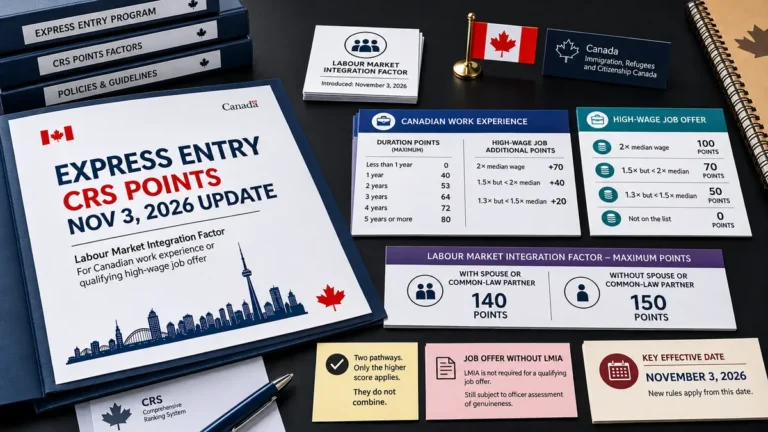
CRS Points Express Entry: November 3 Changes
Haiti Open Work Permit Renewals Policy