Canada’s November 3, 2026 Express Entry changes have introduced new opportunities to earn CRS points through qualifying Canadian work experience and high-wage job offers. But what happens when the applicant owns or controls the Canadian company where they work?

For entrepreneurs holding C11 work permits and executives working under Intra-Company Transfer (ICT) permits, the answer requires more than identifying an eligible occupation or calculating a salary. Canadian immigration law distinguishes between self-employment, qualifying employment experience, and genuine offers of employment.
The central rule remains unchanged: self-employment is generally excluded when calculating qualifying Canadian work experience under Express Entry. However, the new job offer provisions establish a separate legal assessment that must not be confused with the rules governing past employment.
This article examines the revised Ministerial Instructions, the Immigration and Refugee Protection Regulations (IRPR), and relevant Federal Court decisions, including Lazar, Zamani, and Kaur.
1. What Changed in the CRS on November 3, 2026?
Effective November 3, 2026, Immigration, Refugees and Citizenship Canada (IRCC) introduced a revised Comprehensive Ranking System (CRS) framework, including a new Labour Market Integration factor.
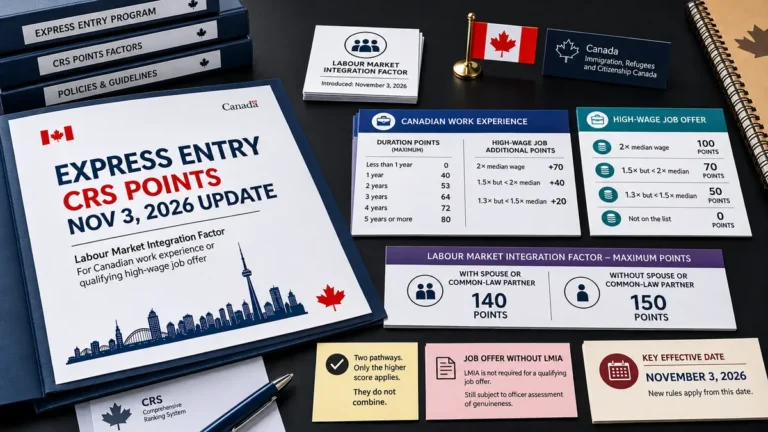
Under section 15 of the revised Express Entry Ministerial Instructions , this factor is calculated by comparing two possible scores:
- Points for qualifying Canadian work experience, including any applicable high-wage occupation supplement.
- Points for a qualifying offer of employment in an eligible high-wage occupation.
The applicant receives the higher of these two scores. The two routes cannot be added together.
The maximum Labour Market Integration score is 150 points without an accompanying spouse or common-law partner and 140 points with an accompanying spouse or common-law partner. The maximum overall CRS score is now 1,270 points.
New Canadian Work Experience and Job Offer Points
| CRS component | Available points |
|---|---|
| One year of qualifying Canadian work experience | 35–40 |
| Two years of qualifying Canadian work experience | 46–53 |
| Five or more years of qualifying Canadian work experience | 70–80 |
| Additional qualifying high-wage Canadian experience | 20, 40 or 70 |
| Qualifying high-wage job offer | 50, 70 or 100 |
The Canadian work experience points depend on whether the applicant has an accompanying spouse or common-law partner. The additional high-wage experience points require at least 12 months of qualifying Canadian work experience in eligible occupations.
Importantly, IRCC determines high-wage occupation levels using national median wage information for the relevant National Occupational Classification (NOC) group. The individual’s actual salary does not independently determine the occupation’s high-wage category.
For the broader scoring framework, see the Express Entry CRS Score Guide and the Express Entry High-Wage Occupations Guide .
2. Does Self-Employment Count as Canadian Work Experience?
This is the most important legal issue for many C11 entrepreneurs and owner-managers.
Paragraph 15.1(6)(b) of the revised Ministerial Instructions expressly excludes self-employment when calculating Canadian work experience under paragraph 15.1(2)(b).
“a period of self-employment is not to be included”
The November 2026 amendments did not remove this exclusion. Consequently, creating a corporation, obtaining a work permit, paying oneself a salary, or performing managerial duties does not automatically establish qualifying Canadian work experience.
The same general exclusion appears in paragraph 87.1(3)(b) of the IRPR , governing work experience under the Canadian Experience Class (CEC).
Under that provision, periods of self-employment or unauthorized work cannot be counted toward the qualifying Canadian experience required for CEC.
Certain physicians providing publicly funded medical services benefit from specific exceptions under the applicable framework. Those exceptions do not create a general exemption for business owners, entrepreneurs, or company directors.
Legal distinction: operating a legitimate Canadian business and accumulating qualifying Canadian employment experience are not necessarily the same thing.
3. Can C11 Work Permit Holders Receive CRS Points?
C11 work permits are generally issued under the International Mobility Program to qualifying entrepreneurs or self-employed persons whose activities are expected to provide a significant benefit to Canada.
A C11 permit may authorize an individual to establish and operate a business. However, authorization to perform that work does not determine whether the resulting experience is eligible for CRS purposes.
Example: A Business Owner Working as CEO
Consider an entrepreneur who establishes a corporation in Ontario, owns all its shares, and works as its chief executive officer.
The company has employees, customers, contracts, commercial revenue, and proper accounting records. The entrepreneur receives a regular salary and obtains a T4 slip each year.
These facts may demonstrate genuine business operations. They do not, by themselves, determine whether the person’s work qualifies as employment rather than self-employment under the applicable immigration rules.
The critical question is the real nature of the relationship between the individual and the corporation.
Does Incorporation Change the Legal Result?
A corporation has a legal personality distinct from its shareholders. However, corporate separation does not automatically resolve the question of self-employment under immigration law.
Relevant considerations may include:
- The applicant’s percentage of share ownership.
- The applicant’s practical control over the business.
- Authority to appoint or dismiss directors and managers.
- Control over compensation and employment conditions.
- Whether meaningful independent supervision exists.
- The substance of the applicant’s daily responsibilities.
- The consistency of corporate, payroll and operational records.
These factors require an assessment of the evidence. The legislation does not prescribe a universal percentage of share ownership that automatically determines self-employment in every case.
Nevertheless, substantial ownership combined with effective management control may provide strong evidence supporting a finding of self-employment.
4. Federal Court: Lazar v. Canada, 2017 FC 16
In Lazar v. Canada (Citizenship and Immigration), 2017 FC 16 , the Federal Court considered a Canadian Experience Class application involving an individual who owned approximately 90% of a company and served as its president.
The immigration officer concluded that the applicant’s substantial ownership and management control supported treating the claimed experience as self-employment.
The Federal Court upheld the reasonableness of that determination.
The decision is important because it demonstrates that the existence of a separately incorporated business is not necessarily decisive when assessing self-employment for CEC purposes.
Instead, ownership and control of the business may be central to the analysis.
Practical implication: an owner-manager cannot assume that employment contracts, payroll deductions, or corporate documentation will override substantial evidence of effective ownership and control.
However, Lazar should not be interpreted as creating a statutory rule that ownership of 90%, or any other fixed percentage, automatically makes every applicant self-employed. The decision must be understood in its factual and legal context.
5. Can ICT Work Permit Holders Claim Canadian Work Experience?
Intra-Company Transfer (ICT) arrangements may involve executives, senior managers, or specialized-knowledge employees transferred from a foreign business to a qualifying Canadian enterprise.
Some ICT employees work within an established corporate structure and have no substantial ownership interest in the Canadian business.
Others may own or control both the foreign enterprise and the Canadian corporation.
These situations should not automatically receive the same treatment.
ICT Scenario A: A Transferred Employee
A multinational company transfers a senior manager to its Canadian subsidiary. The manager works under an established employment relationship, performs qualifying NOC duties, and does not exercise controlling ownership over the business.
Subject to the remaining statutory requirements, the Canadian work experience may qualify for CRS points.
ICT Scenario B: A Controlling Shareholder
An entrepreneur owns a foreign corporation, establishes a related Canadian company, and transfers to Canada as president of the Canadian business.
Although the work permit was issued under the ICT framework, the applicant’s ownership and control may raise questions about whether the work constitutes qualifying employment or self-employment.
The ICT designation alone cannot conclusively answer that question.
6. Federal Court: Zamani v. Canada, 2023 FC 19
In Zamani v. Canada (Citizenship and Immigration), 2023 FC 19 , the Federal Court examined a CEC refusal involving an applicant who had worked in Canada through an intra-company transfer arrangement.
The applicant had been transferred from a foreign business to a related Canadian corporation and held shares in the Canadian enterprise.
The immigration officer characterized the claimed Canadian work as self-employment.
The Court found shortcomings in the officer’s assessment of relevant evidence concerning the corporate and employment relationship, including the circumstances surrounding the ICT authorization.
The judicial review was allowed and the matter was returned for reconsideration.
Important limitation: the Court did not establish that every ICT holder qualifies for Canadian Experience Class or CRS work experience points.
Rather, the decision illustrates the importance of examining the actual evidence and providing a reasoned assessment of the employment relationship.
Zamani is therefore particularly relevant to cases where a finding of self-employment is based primarily on share ownership without sufficient consideration of the wider corporate and employment arrangement.
7. Federal Court: Kaur v. Canada, 2024 FC 1427
In Kaur v. Canada (Citizenship and Immigration), 2024 FC 1427, the Federal Court considered the exclusion of self-employment from Canadian Experience Class eligibility in a case involving business activity conducted under a C11 work permit.
The applicant’s Canadian work experience had been accumulated through the operation of her own business. The self-employed character of the work was not disputed.
The Court dismissed the application for judicial review, recognizing that the applicable CEC regulations did not permit the excluded self-employment experience to be counted.
The decision demonstrates that holding a valid entrepreneur work permit and performing skilled occupational duties cannot displace an express statutory exclusion.
Legal significance: where the work is properly characterized as self-employment, the fact that it was authorized under C11 does not make it qualifying CEC experience.
This decision concerns CEC eligibility under the applicable regulatory framework. It does not, by itself, determine whether an owner-controlled corporation can make a qualifying job offer under the new November 2026 CRS provisions.
8. Can a Business Owner Obtain CRS Points Through Their Own Company’s Job Offer?
This is a distinct legal question arising from the November 2026 reforms.
Under section 15.2 of the revised Ministerial Instructions , qualifying offers of employment in designated high-wage occupations may attract 50, 70, or 100 CRS points.
The revised framework also removes the previous LMIA requirement for qualifying offers used to obtain CRS points.
However, removal of the LMIA requirement does not eliminate the need to establish that an offer is genuine and otherwise qualifies.
Requirements for a Qualifying Job Offer
For an ordinary TEER 0–3 position, the offer must generally be for paid, full-time, continuous employment in Canada for at least one year from the issuance of the permanent resident visa.
Special rules apply to certain occupations, including designated medical occupations and skilled trades.
Under subsection 15.2(4), the immigration officer must be satisfied that the offer is genuine.
The assessment includes whether:
- The employer is actively engaged in the business for which the offer is made.
- The offer reflects the employer’s reasonable employment needs.
- The employer can reasonably fulfill the proposed employment terms.
- The applicant is qualified and able to perform the work.
- The applicant is likely to accept and carry out the employment.
- The employer has complied with applicable federal and provincial employment and recruitment laws.
What If the Applicant Controls the Employer?
The revised CRS provisions do not expressly establish a blanket exclusion for every job offer made by a corporation in which the applicant holds an ownership interest.
Nevertheless, this statutory silence should not be interpreted as confirmation that an owner-controlled employment arrangement qualifies for CRS points.
Where the applicant exercises substantial control over the issuing corporation, the officer’s assessment may raise additional factual questions.
These questions may concern the genuine operational need for the position, the company’s financial capacity, the proposed employment terms, and the credibility of the employment arrangement.
An active corporation may genuinely require the services of a senior executive. However, the existence of a legitimate company does not independently prove that a particular offer satisfies subsection 15.2(4).
Therefore, it would be premature to conclude that all owner-issued offers qualify or that all such offers are automatically prohibited.
The specific circumstances and statutory requirements must be assessed before CRS points are claimed.
9. Does a CEO Position Qualify for 100 CRS Points?
Not automatically.
Certain senior management occupations appear on IRCC’s designated high-wage occupation list. Depending on the applicable NOC, a qualifying job offer may be worth 70 or 100 points.
| NOC 2021 | Occupation | Potential job offer points |
|---|---|---|
| 00012 | Senior managers — financial, communications and other business services | 100 |
| 00013 | Senior managers — health, education, social and community services and membership organizations | 100 |
| 00014 | Senior managers — trade, broadcasting and other services | 70 |
| 00015 | Senior managers — construction, transportation, production and utilities | 70 |
The job title alone does not determine NOC classification. The applicant’s actual duties, organizational responsibilities and the nature of the business must support the claimed NOC.
A person operating a small corporation may perform a combination of management, sales, administration and operational duties. Calling that individual a CEO does not necessarily establish that the position meets the requirements of a senior management NOC.
Applicants should consult the High-Wage Occupations NOC List and use the High-Wage CRS Calculator only after determining that the relevant employment experience or offer is eligible.
10. Applicant Question: I Own 100% of My Company. Can I Claim 100 CRS Points?
Question from a C11 Entrepreneur
“I entered Canada under a C11 work permit and established my own corporation. I own 100% of the shares and work as CEO.
My company is active, has employees, pays taxes, and generates revenue. I also receive a regular salary and have T4 slips.
My occupation appears in the 100-point high-wage category. Under the new rules, can my company issue me a job offer worth 100 CRS points?”
Legal Analysis
Not automatically. Two separate legal questions must be considered.
First: Does the Past Work Qualify as Canadian Experience?
Because the applicant wholly owns and operates the company, the self-employment exclusion requires careful consideration.
The applicant’s C11 authorization, T4 slips, corporate tax filings and business activities do not independently establish eligible Canadian work experience.
The decisions in Lazar and Kaur demonstrate the importance of applying the self-employment exclusion according to the substance of the working arrangement.
Second: Does the Company Have a Qualifying Job Offer?
This is a separate assessment under section 15.2 of the revised Ministerial Instructions.
A position appearing in the 100-point occupational category is not enough. The proposed offer must independently satisfy the applicable statutory requirements.
Where the applicant controls the employer, particular attention should be given to:
- Whether the position responds to a genuine and continuing business need.
- Whether the corporation has sufficient financial and operational capacity.
- Whether the proposed employment terms are credible and capable of performance.
- Whether the claimed occupation accurately reflects the work to be performed.
- Whether the supporting corporate and financial evidence is consistent.
The legislation does not expressly disqualify every applicant simply because they own shares in the employer. However, it also does not guarantee acceptance of an offer issued by a company under the applicant’s control.
Conclusion: potential eligibility for job offer points requires an individual legal and evidentiary assessment. The information provided is insufficient to establish an entitlement to 100 CRS points.
Furthermore, receiving CRS points does not, by itself, establish eligibility for permanent residence under an Express Entry immigration program.
11. CEC Eligibility and CRS Points Are Separate Questions
The Canadian Experience Class has its own statutory requirements under section 87.1 of the IRPR .
A candidate must establish the required qualifying Canadian work experience, language proficiency, and other applicable conditions.
The November 2026 CRS amendments do not convert excluded self-employment into qualifying Canadian Experience Class work experience.
Three distinct questions should therefore be addressed:
| Legal issue | Required assessment |
|---|---|
| CEC eligibility | Does the applicant have qualifying Canadian employment experience under IRPR section 87.1? |
| CRS Canadian work experience | Does the claimed experience satisfy section 15.1 of the Ministerial Instructions? |
| CRS job offer points | Does the proposed offer satisfy section 15.2, including the genuineness test? |
An applicant who does not qualify under CEC may still be eligible for Express Entry through another qualifying program, such as the Federal Skilled Worker Program.
However, program eligibility must be established independently of the applicant’s projected CRS score.
For an overview of the selection framework, read the Express Entry Immigration Guide .
12. Evidence That Business Owners and ICT Applicants Should Review
Before claiming Canadian work experience or job offer points, applicants should conduct a structured review of the available evidence.
Depending on the circumstances, relevant documents may include:
- Current and previous work permits, including original supporting submissions.
- Articles of incorporation, shareholder registers and ownership records.
- Corporate governance documents and board resolutions.
- Employment agreements and records of reporting relationships.
- Payroll records, T4 slips and relevant income tax documents.
- Business financial statements, bank records and commercial contracts.
- Organizational charts and evidence of operational responsibilities.
- Records supporting the applicant’s actual NOC duties.
- Written job offers and evidence supporting the employer’s operational need.
- Documents demonstrating the company’s ability to fulfill the proposed employment terms.
These documents are not interchangeable. Different documents establish different legal and factual elements.
For example, incorporation documents establish the company’s legal structure. They do not independently determine whether a shareholder’s activities constitute qualifying employment.
Similarly, financial statements may support a company’s operating capacity but do not independently establish the genuineness of a particular job offer.
A sound application should address these distinctions directly rather than relying on a large collection of documents without a clear evidentiary explanation.
13. What Should C11 and ICT Applicants Do Before Updating Their Profiles?
Applicants should first identify which Labour Market Integration route is potentially available.
If Claiming Canadian Work Experience
- Determine whether the work constitutes qualifying employment or excluded self-employment.
- Confirm the relevant employment dates, hours and work authorization.
- Establish the correct NOC classification.
- Determine whether any high-wage experience supplement applies.
If Claiming Job Offer Points
- Confirm the proposed occupation appears on the applicable high-wage list.
- Determine whether the offer satisfies section 15.2.
- Assess the genuineness of the offer and the employer’s operational needs.
- Review any ownership or control issues that may affect the supporting evidence.
IRCC has also published temporary instructions addressing differences between the new LMIA rules and existing online Express Entry profile fields.
Applicants should follow the official November 2026 transition instructions before entering job offer information.
The removal of an LMIA requirement for Express Entry job offer assessment should not be confused with authorization to work in Canada. Temporary work permit requirements remain a separate issue.
14. Frequently Asked Questions
Can I receive CRS points with a C11 work permit?
Potentially, but the permit itself does not establish eligibility. Canadian work experience must satisfy the applicable CRS requirements, including the self-employment exclusion.
Can an ICT manager receive high-wage CRS points?
Yes, where the manager has qualifying Canadian employment experience in an eligible high-wage occupation, the additional experience points may apply. ICT status alone is not sufficient.
Does receiving a T4 mean I am not self-employed?
No. A T4 can be relevant evidence, but the real nature of the employment relationship, including ownership and management control, must be assessed.
Can a company offer a job to its own shareholder?
The revised CRS provisions do not expressly prohibit every shareholder-related job offer. However, an offer must satisfy section 15.2, including the officer’s genuineness assessment. Eligibility cannot be presumed from incorporation or share ownership alone.
Will earning a high salary automatically give me 100 points?
No. High-wage levels are based on national median wage classifications for eligible NOC occupations, not an individual’s actual salary.
Can I combine Canadian work experience points and job offer points?
No. IRCC compares the applicable Canadian work experience route, including any high-wage experience supplement, with the qualifying job offer route. The higher score is assigned.
Does an ICT work permit prove I am an employee for CEC?
Not conclusively. The original ICT authorization may be relevant evidence, but CEC eligibility requires a separate assessment of the actual work experience under the applicable regulations.
Can self-employment qualify under the Federal Skilled Worker Program?
Qualifying self-employed experience may be relevant to Federal Skilled Worker eligibility if the applicant meets that program’s requirements. However, eligibility for that program does not automatically convert Canadian self-employment into qualifying Canadian work experience for CRS purposes.
Does the removal of LMIA requirements guarantee job offer points?
No. The revised rules remove the LMIA requirement for qualifying Express Entry job offers, but statutory eligibility and the genuineness assessment remain applicable.
15. Conclusion: Do C11 and ICT Business Owners Qualify for the New CRS Points?
The November 3, 2026 Express Entry reforms introduce new opportunities for candidates with qualifying Canadian work experience or genuine high-wage job offers.
However, these reforms do not eliminate the distinction between self-employment and qualifying Canadian employment experience.
The Federal Court decisions in Lazar, Zamani, and Kaur demonstrate why the specific facts of an owner’s or executive’s working relationship matter when assessing self-employment under the Canadian Experience Class.
Those decisions should not be treated as automatically resolving the separate and newly amended job offer provisions in section 15.2.
C11 and ICT applicants are neither automatically entitled to nor automatically excluded from all new CRS points solely because of their work permit category.
Qualifying Canadian experience, self-employment classification, genuine job offers, and eligibility under an Express Entry immigration program must each be examined under the appropriate legal test.
For owner-managers and corporate executives, a detailed assessment of the corporate structure, actual employment relationship and supporting evidence is essential before claiming CRS points.
Official Sources and Relevant Case Law
- IRCC — Express Entry Ministerial Instructions, sections 15, 15.1 and 15.2.
- Ministerial Instructions Amending the Express Entry System, 2026-1.
- IRCC — 2026 Changes to Canadian Work Experience and Job Offer Points.
- Immigration and Refugee Protection Regulations, section 87.1.
- IRCC — Express Entry Job Offer Requirements.
- Lazar v. Canada (Citizenship and Immigration), 2017 FC 16.
- Zamani v. Canada (Citizenship and Immigration), 2023 FC 19.
- Kaur v. Canada (Citizenship and Immigration), 2024 FC 1427.
This article provides general immigration information and legal analysis. It does not constitute an individualized eligibility determination or guarantee of CRS points, an invitation to apply, or permanent residence.
Disclaimer
Maplevisa provides Canadian immigration news and information for general informational purposes only. Content is not legal or immigration advice and should not be relied upon as a substitute for advice based on your individual circumstances. Immigration laws, policies, programs, and procedures may change. Where applicable, readers should consult the relevant official government or legal source for current information.
More Immigration News

Rural Community Immigration Program becomes permanent

Apply for Canadian Citizenship Online or on Paper

Alberta AAIP Issues 425 Invitations in 5 Rounds

Manitoba PNP Draw 283 Issues 526 Invitations Nov. 5, 2026

Canada’s 2027–2029 Immigration Levels Plan: What Changes
Apply for Canada Study Permit 2027
CRS Points Express Entry: November 3 Changes

Haiti Open Work Permit Renewals Policy

Sudan Open Work Permit Renewal Policy in Canada