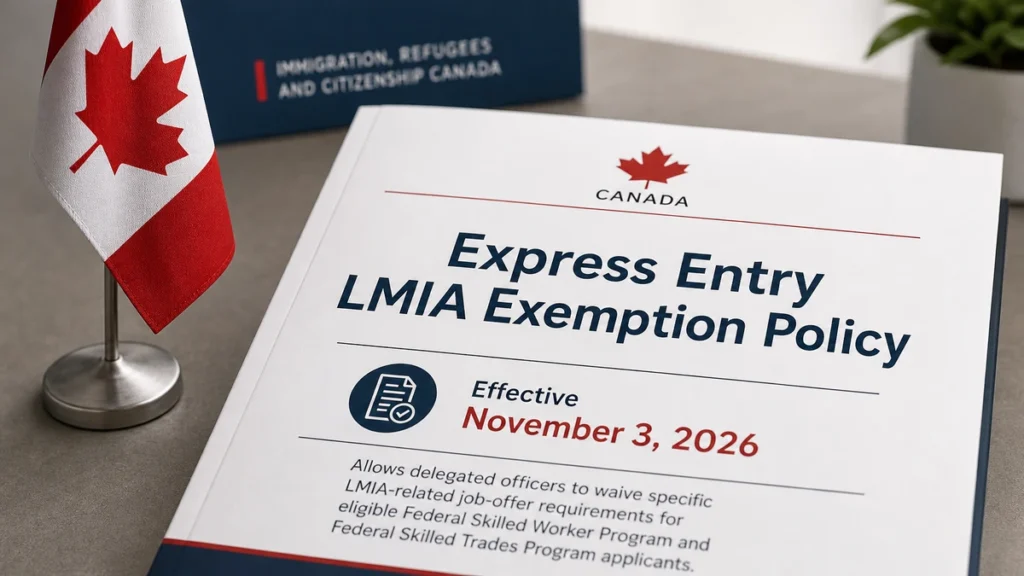
Canada’s Express Entry LMIA exemption policy takes effect on November 3, 2026. It allows delegated officers to exempt eligible Federal Skilled Worker Program and Federal Skilled Trades Program applicants from specified LMIA-related job-offer requirements when processing their permanent resident visa applications.
Who can be considered for an exemption
An Express Entry invitation issued on or after November 3, 2026, is required. The applicant must have submitted a permanent residence application under section 70 of the Immigration and Refugee Protection Regulations (IRPR) in the Federal Skilled Worker Class or Federal Skilled Trades Class.
IRCC officers may grant the exemptions if the applicant meets the policy conditions. Read what to do after an Express Entry invitation to apply for the next steps.
Conditions for the job offer
Federal Skilled Worker applicants need arranged employment as defined in subsection 82(1) of the IRPR. Federal Skilled Trades applicants need an offer of employment. IRCC assesses both types of offer against the same five conditions without a separate Labour Market Impact Assessment (LMIA) where the exemptions apply.
- The employer must be actively engaged in the business for which it is making the offer.
- The offer must be consistent with the employer’s reasonable employment needs.
- The offer’s terms must be ones the employer can reasonably fulfil.
- The employment must be in an occupation for which the foreign national has past work experience or education.
- The employer must not have previous non-compliance with federal or provincial laws regulating the employment or recruitment of employees, including foreign nationals, in the province where the person is intended to work.
Requirements that may be exempted
For Federal Skilled Worker applicants, the policy lists exemptions under IRPR subparagraphs 82(2)(a)(i)–(iii), 82(2)(b)(i)–(iii), 82(2)(c)(ii) and 82(2)(d)(iii). These cover specified LMIA, work permit, employer and prior work requirements. Officers may also waive the related requirement under paragraph 83(1)(e) to receive Federal Skilled Worker selection points for employment in Canada.
For Federal Skilled Trades applicants, the exemptions are under clauses 87.2(3)(d)(ii)(A), (B) and (D), (iii)(A), (C) and (D), (iv)(C) and (v)(C). These cover specified LMIA and work permit requirements, including those tied to offers from up to two employers named on the permit.
Where the listed provisions apply, officers may also waive the requirement for one continuous year of full-time work, or the part-time equivalent, with the relevant employer or employers.
How the exemption relates to CRS points and work permits
This policy covers job offers used for Federal Skilled Worker or Federal Skilled Trades eligibility. Separate Express Entry Ministerial Instructions, amended on November 3, 2026, govern CRS points for job offers and Canadian work experience in high-wage occupations. An offer that meets the policy conditions does not automatically qualify for CRS points.
The policy applies when IRCC processes a permanent residence application. If you need a work permit, check the requirements for that permit separately.
What remains required
The public policy does not remove all permanent residence requirements. Applicants eligible under it remain subject to all other legislative obligations, admissibility requirements and selection criteria that are not exempted by this or another public policy.
Applicants and employers should be prepared to show how the application, employer and job offer meet the policy conditions.
Effective date and duration
The policy takes effect on November 3, 2026. It remains in effect until the Minister revokes it and may be revoked at any time.
The policy is intended to reduce administrative burden for affected applicants and employers, improve the timeliness and efficiency of job-offer assessments, and support more consistent decision-making regardless of an applicant’s work permit type or status.
Source: IRCC Public Policies
Disclaimer
Maplevisa provides Canadian immigration news and information for general informational purposes only. Content is not legal or immigration advice and should not be relied upon as a substitute for advice based on your individual circumstances. Immigration laws, policies, programs, and procedures may change. Where applicable, readers should consult the relevant official government or legal source for current information.
More Immigration News
Canada Accelerates Hong Kong and Ukraine PR Applications

Canada Immigration Processing Times on 10 November 2026
C11 & ICT CRS Points: 2026 Rules for Business Owners

Rural Community Immigration Program becomes permanent

Apply for Canadian Citizenship Online or on Paper

Alberta AAIP Issues 425 Invitations in 5 Rounds
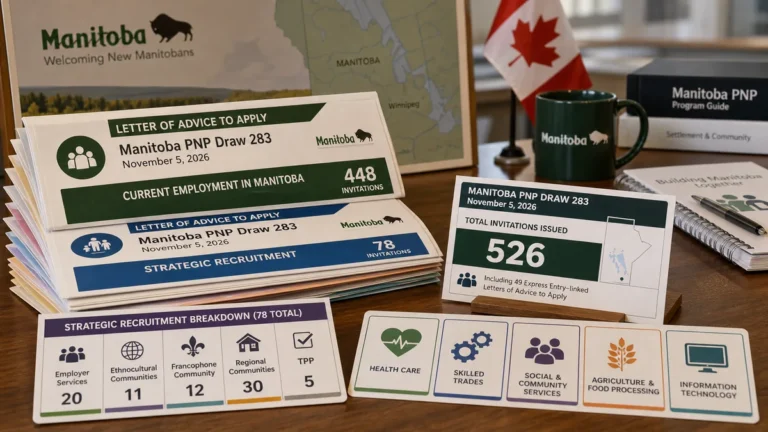
Manitoba PNP Draw 283 Issues 526 Invitations Nov. 5, 2026

Canada’s 2027–2029 Immigration Levels Plan: What Changes
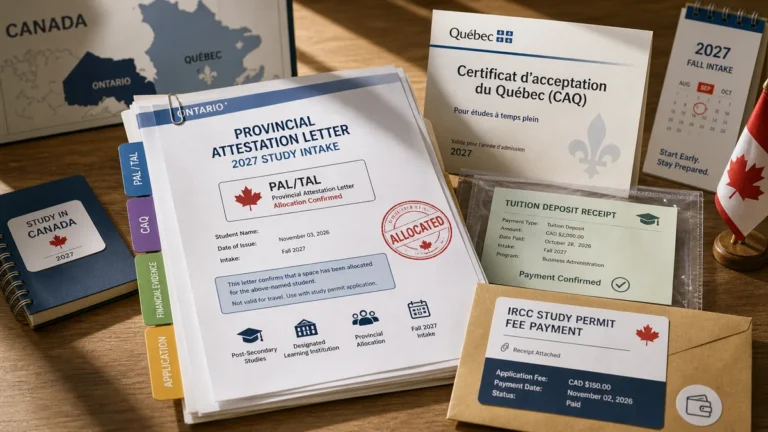
Apply for Canada Study Permit 2027