Most eligible applicants can apply for Canadian citizenship online, including families and groups. Apply on paper if you count eligible Crown service abroad toward physical presence or want a representative to complete and submit your application.

Canadian citizenship online vs. on paper
The online application has built-in checks and provides immediate confirmation after submission. Paper applications go through an extra intake step while IRCC digitizes them.
Both methods use the same citizenship eligibility rules. If you are eligible for both, online filing is usually simpler. Use the paper package if either exception below applies.
| Who can use it | Most eligible adults, adult groups, and eligible minors through a parent, guardian or, in limited circumstances, the minor themself. | Available to eligible applicants and mandatory in specific exception cases. |
| When paper is required | Not available if Crown-servant time outside Canada is included in physical presence, or if a representative will complete and submit the application. | Required in those two situations. A representative may still help with an online application, but the applicant must personally complete, sign and submit it. |
| Submission confirmation | IRCC receives it immediately after submission and sends a confirmation email. That email is not an acknowledgement of receipt (AOR). | The applicant must wait for delivery, completeness review and an AOR. Courier or postal tracking can confirm delivery only. |
| Completeness safeguards | The portal uses built-in checks intended to catch some errors before submission. | IRCC scans and manually enters the package; an incomplete package may be returned by mail. |
| Status tracking | After the AOR, the applicant can create a citizenship tracker account using the application number, UCI and email address used in the application. | Paper applicants can also use the citizenship tracker after receiving an AOR. |
| Fees | The same government fees apply; payment instructions appear in the online account. | Fees are paid online and the payment receipt is included with the package. |
Canadian citizenship eligibility
Before deciding how to apply for citizenship Canada, first confirm that you are applying for a citizenship grant rather than proof of citizenship. A person born outside Canada to a Canadian parent, for example, may already be a citizen and may need a citizenship certificate instead of a grant application.
Being married to a Canadian citizen does not remove the normal citizenship requirements.
For an adult citizenship grant, the key Canada citizenship eligibility checklist is largely the same regardless of online or paper filing. You must hold permanent resident status, although your PR card may be valid or expired.
You must generally have at least 1,095 days of physical presence in Canada during the five years immediately before signing, including at least 730 days as a permanent resident.
Some pre-PR time in Canada as a temporary resident or protected person can count at one-half day, up to a maximum credit of 365 days.
You may need to have filed Canadian income tax for at least three years in the relevant five-year period. Adults aged 18 to 54 when they sign must provide evidence of English or French ability and will normally be required to take the citizenship test later in the process.
Applicants aged 55 or older are exempt from the language and knowledge-test requirements, but they must still meet the other applicable eligibility requirements. Citizenship cannot be approved while an applicant is subject to a prohibition, which can arise from specified criminal or security circumstances.
Rules for children depend on the minor's situation. A minor with a Canadian parent, or a parent applying for citizenship at the same time, normally applies under the minor 5(2) process and does not need to meet a physical-presence requirement.
A minor without either of those connections generally applies under minor 5(1), which includes a 1,095-day physical-presence requirement. Minors do not need language proof or a citizenship test; minors aged 14 to 17 normally take the oath if approved.
How to apply for Canadian citizenship online
If you can apply for Canadian citizenship online, IRCC's online account is usually the most efficient route. It is not limited to single adult applicants.
If no one can apply on a minor’s behalf and the minor has neither a Canadian parent nor a parent applying at the same time, IRCC directs the minor to apply online on their own.
Eligible adults can apply as a group, and each adult has an individual account linked to the group. A parent or legal guardian can also create and manage online applications for eligible minors; one adult account can include up to 20 minor applications.
Adults must not share account passwords, and each adult signs their own application.
A representative can provide advice or help an applicant answer questions online, but the applicant must create the account with their own email address, keep their login credentials private, complete the application, sign it and submit it themself.
If the applicant wants the representative to complete and submit the application, the correct route is paper. This distinction matters for applicants using an immigration consultant, lawyer, family member or friend.
A typical online process is: confirm eligibility; create the citizenship application account; choose the correct adult or minor application; complete the questions; upload the documents the account requests; pay the fee and upload the receipt where required; electronically sign and submit.
For a linked adult group, one adult submits the group after every adult has signed. The immediate submission confirmation is useful evidence that IRCC received the electronic filing, but it is not the AOR and does not mean IRCC has found the application complete.
- Use clear, complete digital copies and follow the document format and file instructions shown in the account.
- Keep the physical presence calculation consistent with the date you sign the application.
- Do not share the portal password with a representative or co-applicant.
- Keep copies of submitted documents, the payment receipt and the submission confirmation.
- Respond promptly if IRCC later requests additional documents, fingerprints, an interview, a test or oath-related information.
When to apply for Canadian citizenship on paper
The Canadian citizenship application paper vs online decision is not simply a personal preference question. IRCC says you or your child must apply on paper if the physical presence calculation includes time outside Canada as a Crown servant or as the family member of a Crown servant.
Paper filing is also required if you want a representative to complete and submit the application for you or your child.
A minor under 18 is not, by itself, a paper-filing exception. Likewise, an applicant who needs accessibility accommodation does not automatically have to submit a paper application.
IRCC's adult and minor forms ask applicants to identify special needs, with examples including wheelchair access, sign-language interpretation, personal assistance and accessible-format materials. Applicants should describe the required accommodation in the application and follow IRCC's instructions rather than assuming paper is mandatory.
For a paper application, make sure the form is signed and dated on the day it is signed, and that the date matches the application date on the physical-presence calculator output. IRCC says it may return a paper application received more than 90 days after the form date.
If a family or group wants IRCC to process paper applications together, the complete applications and receipts should go in the same envelope; an incomplete application can result in all submitted group applications being returned.
- Download the current application package and document checklist immediately before preparing a paper application; do not rely on old saved forms.
- Pay the applicable fee online and include the receipt in the package.
- Print the online physical presence calculation when it is required for your application type.
- Include translations and required translator documentation for documents not in English or French.
- Use the current IRCC mailing or courier address listed in the application instructions, because intake addresses can change.
Canadian citizenship processing and tracking
Online filing is faster at the intake stage, not necessarily a promise of a faster final citizenship decision. IRCC states that online applications are faster and more efficient, while paper applications take longer to begin processing because of digitization and completeness-review steps.
However, IRCC does not publish a separate, guaranteed citizenship application processing time online versus paper for every individual file. Complexity, missing information, travel history, security screening and requests for additional documents can all affect a case.
Both online and paper citizenship-grant applicants can use the citizenship tracker once IRCC issues the AOR. To create the tracker account, an applicant needs their UCI, application number and the email address used in the application.
For online applications, IRCC receives the file immediately and sends a submission-confirmation email, but the applicant still waits for IRCC's completeness review and AOR. For paper applications, postal or courier tracking can show delivery before the AOR is issued.
Canadian citizenship fees and documents
The current IRCC fee is CAD 653 for an adult and CAD 100 for a minor. The adult total includes CAD 530 for processing and CAD 123 for the right of citizenship.
The exact documents depend on whether the applicant is an adult, minor 5(1) or minor 5(2), and on the answers given in the application.
For adults, the physical presence calculation is central: the paper adult form requires the printout of the online calculation, and its application date must match the signature date.
The form also collects passport and travel-document information for the five-year eligibility period, tax information and five years of work, study and activity history without gaps.
Adults aged 18 to 54 need acceptable language evidence showing at least Canadian Language Benchmarks or Niveaux de compétence linguistique canadiens level 4 in speaking and listening. Examples include eligible education records, accepted third-party language-test results and certain government-funded language-training records.
An applicant who has an old test result accepted for an earlier immigration or citizenship purpose may still be able to use it, even if the result has expired.
- Required application form or completed online application for the correct adult or minor category.
- Fee receipt showing the correct current amount.
- Passport and travel-document details for the relevant eligibility period.
- Supporting identity and immigration-status documents requested by the current checklist or online account.
- Language proof for applicants aged 18 to 54, unless a waiver is requested and supported.
- Translations and supporting translator materials for documents not in English or French.
Source: Apply for Canadian citizenship: adults and minor children — How to apply
Disclaimer
Maplevisa provides Canadian immigration news and information for general informational purposes only. Content is not legal or immigration advice and should not be relied upon as a substitute for advice based on your individual circumstances. Immigration laws, policies, programs, and procedures may change. Where applicable, readers should consult the relevant official government or legal source for current information.
More Immigration News

Alberta AAIP Issues 425 Invitations in 5 Rounds
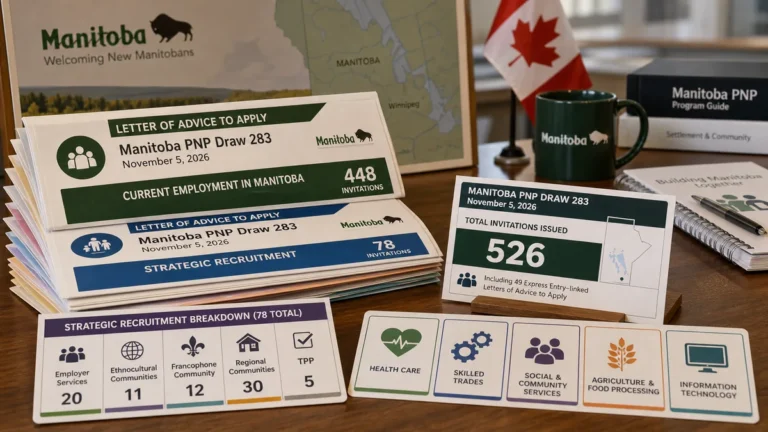
Manitoba PNP Draw 283 Issues 526 Invitations Nov. 5, 2026

Canada’s 2027–2029 Immigration Levels Plan: What Changes
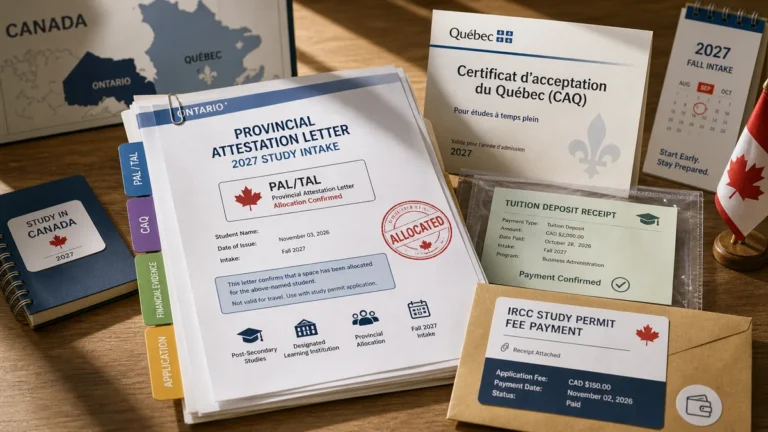
Apply for Canada Study Permit 2027
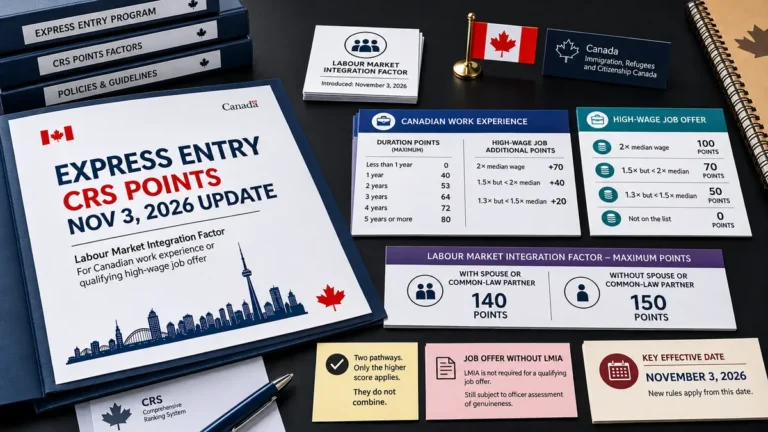
CRS Points Express Entry: November 3 Changes

Haiti Open Work Permit Renewals Policy
Sudan Open Work Permit Renewal Policy in Canada

Canada Immigration Processing Times on 1 November 2026
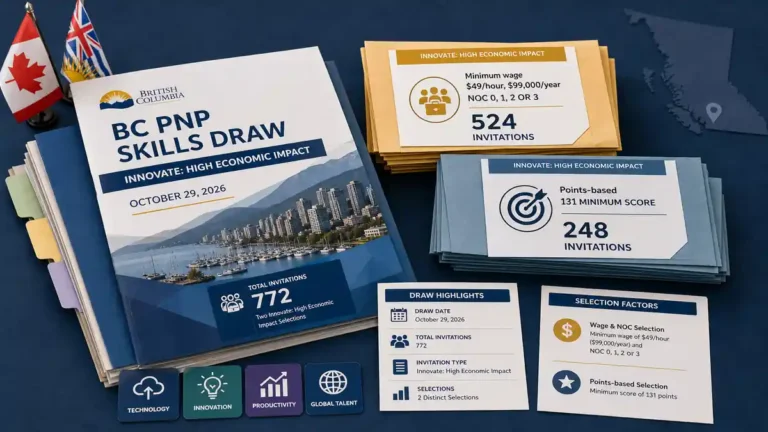
BC PNP Skills Draw Issues 772 ITAs on October 29, 2026