
The Federal Court has dismissed a judicial review application challenging the Refugee Appeal Division’s refusal of a refugee claim over conflicting identity documents. In Niyomugabo v. Canada (Citizenship and Immigration), 2026 FC 1239, the Court found the RAD’s assessment of the applicant’s refugee identity documents and credibility was reasonable.
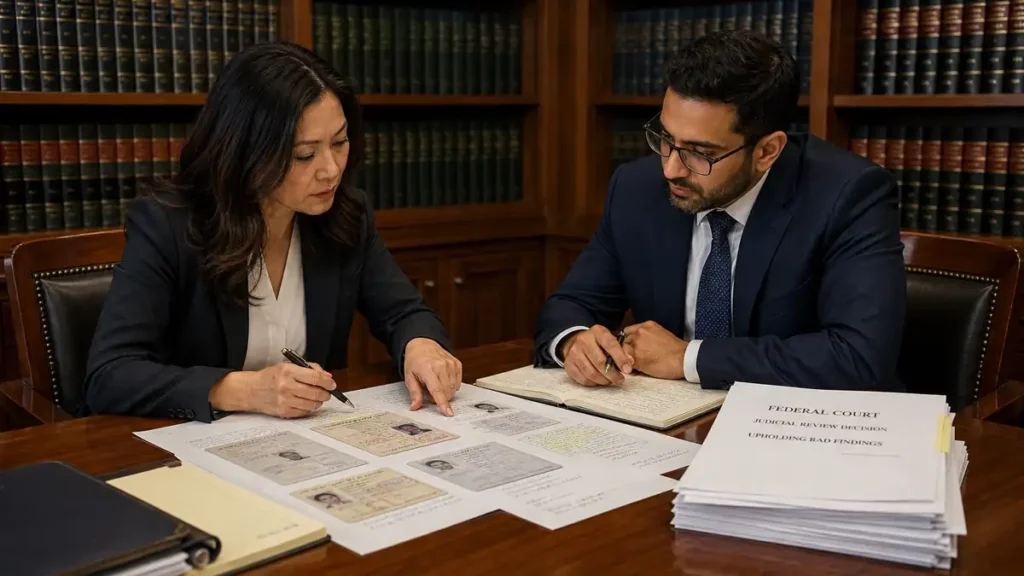
Case and decision under review
The decision was issued in Toronto on October 7, 2026, by Mr. Justice Sébastien Grammond in court file IMM-16301-25.
The applicant alleged that he was a Rwandan citizen, although he was born in the Democratic Republic of Congo (DRC), and claimed fear of persecution by the Rwandan military. The Refugee Protection Division and then the Refugee Appeal Division dismissed his claim solely because he had not established his identity with acceptable documentation or provided a reasonable explanation.
Conflicting documents were central to the claim
The applicant relied on two contradictory sets of documents: a Rwandan passport and birth certificate stating that he was born in Rwanda, and a DRC voting card suggesting that he was born in the DRC. He testified that he was born in the DRC, moved to Rwanda with his mother at a young age and later obtained Rwandan citizenship.
He said his mother had obtained both sets of documents through some form of misrepresentation. Before the Court, he argued that the RAD had ignored his sworn testimony explaining the inconsistencies.
Court finds no fundamental misapprehension of evidence
Justice Grammond noted that identity and credibility determinations are questions of fact. On judicial review, the Court intervenes only where the decision-maker has fundamentally misapprehended or failed to account for the evidence before it.
The Court found that the RAD had made no such error. It was reasonable for the RAD to conclude that the supporting documents were fraudulent and to draw a negative credibility inference because the applicant had not disclosed the situation in his Basis of Claim form.
The RAD was also entitled to draw a negative inference from the absence of corroborative identity evidence from the applicant’s mother, with whom he remained in close contact.
Citizenship and language arguments did not change result
The applicant also argued that he automatically lost DRC citizenship when he became a Rwandan citizen, which he said explained why he could not obtain additional DRC identity documents. The Court held that the RAD reasonably rejected that explanation. It noted that a Rwandan passport for a naturalized citizen would show a birthplace outside Rwanda, while the applicant’s statement that he obtained Rwandan citizenship in 2010 was unsupported.
The Court also rejected the argument that the RAD had given insufficient weight to the applicant’s ability to speak Kinyarwanda. That issue had not been raised before the RAD. In any event, the Court said language proficiency was relevant but not decisive, as Kinyarwanda is spoken in Rwanda and parts of the DRC.
Application dismissed
The Federal Court dismissed the application for judicial review. No question was certified.
The decision turns on the reasonableness of the RAD’s assessment of the record in this claim. It does not direct a new refugee determination.
Source: Federal Court Decisions