
In Work Permit Misrepresentation, Xu v. Canada, 2026 FC 1236, the Federal Court dismissed two judicial review applications challenging IRCC decisions that refused a work permit and permanent residence application following a finding of misrepresentation. Justice Southcott found the work permit inadmissibility decision reasonable and the processes leading to both decisions procedurally fair.
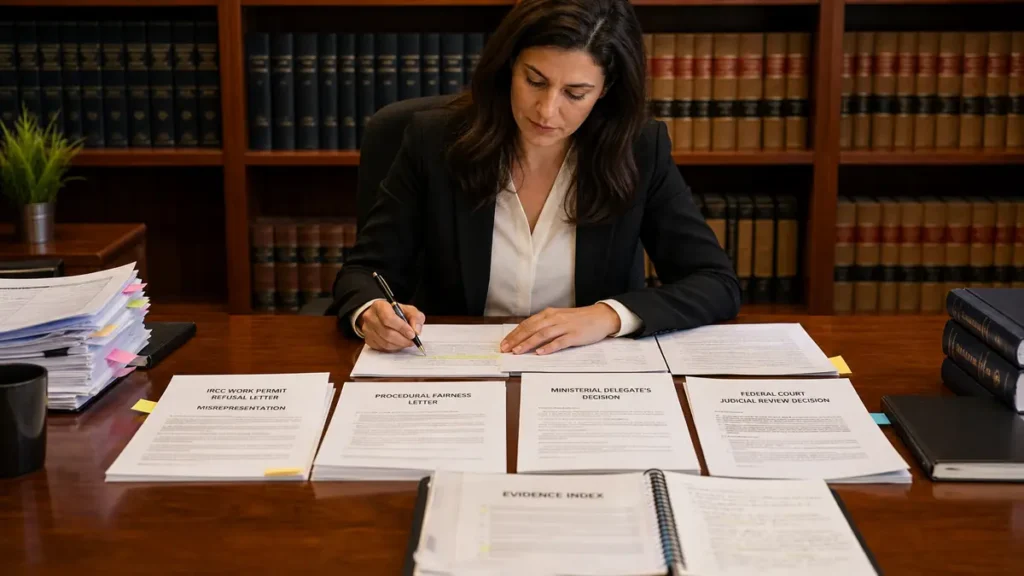
Work permit and permanent residence refusals
The applicant applied for a work permit on March 29, 2023, relying on employment and work experience with Shenzhen Huachuang Rongbo Industry Co. Ltd. Concerns later arose after a November 22, 2024 telephone conversation between an IRCC officer in Shanghai and the applicant’s husband, whose contact information was registered for the company.
IRCC sent the applicant a procedural fairness letter on December 6, 2024, raising concerns that she had misrepresented her employment history. The letter also advised that misrepresentation could result in a five-year inadmissibility period under subsection 40(2) of the Immigration and Refugee Protection Act.
In her response, the applicant said her husband had initially invested in the company and registered his contact information, but that daily operations were handled by a professional manager. She submitted payroll records, sales invoices and receipts in support of her work experience.
On January 9, 2025, a ministerial delegate refused the work permit and found the applicant inadmissible for misrepresentation under paragraph 40(1)(a) of the IRPA. IRCC subsequently refused her permanent residence application on June 2, 2025, based on the inadmissibility finding.
Court finds the inadmissibility decision reasonable
The Court reviewed the merits of the inadmissibility decision on the reasonableness standard. It held that the applicant could not use her husband’s March 2025 affidavit to challenge the merits, because that affidavit was not before the delegate when the January 2025 decision was made.
The applicant argued that the telephone conversation was not enough evidence to support a misrepresentation finding and that IRCC should have contacted the company manager before deciding the matter. The Court rejected that argument.
Justice Southcott noted that IRCC had contemporaneous GCMS notes recording the telephone conversation and that the applicant had an opportunity to respond through the procedural fairness letter. The Court found that the officer’s recommendation and the delegate’s analysis considered both the telephone conversation and the applicant’s response, providing a rational chain of reasoning for preferring the earlier information.
The Court also concluded that the cited authority did not require IRCC to conduct further verification inquiries after the telephone conversation or after receiving the procedural fairness response. It noted that the applicant could have included evidence from the manager in her response.
No procedural unfairness in verification process
The applicant argued that the verification call was unfair because it occurred without notice and in a language other than one of Canada’s official languages. The Court found no evidence that the husband did not understand the language used in the conversation or that using an official language would have made the process fairer.
The Court also held that the absence of advance notice for the telephone conversation was not itself unfair. Following the call, IRCC issued a procedural fairness letter that informed the applicant of the concerns and gave her an opportunity to respond.
Justice Southcott found that procedural fairness did not require IRCC to provide an additional opportunity to address concerns after reviewing the applicant’s response. The procedural fairness letter had put her on notice of the issue she needed to address, including the possibility that her explanation might not be accepted.
Permanent residence challenge also dismissed
The applicant’s challenge to the permanent residence refusal depended substantially on her arguments against the underlying inadmissibility finding. Since the work permit inadmissibility decision withstood judicial review, those arguments did not succeed.
She also argued that IRCC should have allowed her to respond before refusing permanent residence, including by seeking a Temporary Resident Permit or requesting that IRCC delay its decision until the Court decided the work permit matter.
The Court found that the applicant knew of the inadmissibility decision from January 9, 2025 and could have made those requests before the permanent residence decision on June 2, 2025. It held that the permanent residence decision followed effectively as a matter of law from the inadmissibility decision and that no further procedural opportunity was required.
Outcome
The Federal Court dismissed both applications for judicial review in files IMM-3998-25 and IMM-16492-25. No question was certified for appeal.
The decision is a case-specific review of the evidence and procedures used in these applications. It does not itself direct a general change to IRCC policy or procedure.
Source: Federal Court Decisions