The Federal Court dismissed a Pakistani family’s challenge to an Internal Flight Alternative finding, upholding the Refugee Appeal Division’s conclusion that Islamabad, Lahore or Multan were viable relocation options. The judicial review was dismissed without costs.

Case Summary
- Case & citation: Saadi v. Canada (Citizenship and Immigration), 2026 FC 1387, Court file IMM-23811-24.
- Decision date & judge: November 12, 2026, by The Honourable Madam Justice Saint-Fleur.
- Issue: The applicants challenged the RAD’s finding that they had a viable Internal Flight Alternative in Islamabad, Lahore or Multan.
- Outcome: The application for judicial review was dismissed without costs, leaving the RAD decision in place.
RAD decision under review
The five applicants are Pakistani citizens who had lived in the United Arab Emirates. They claimed to face threats in Pakistan from religious extremists, family members and political groups because of their Wahhabi Sunni religious practices.
Their refugee claim was refused by the Refugee Protection Division in July 2024, with the availability of an Internal Flight Alternative (IFA) in Islamabad, Lahore or Multan as the determinative issue. The Refugee Appeal Division upheld that result in November 2024.
The applicants argued that the RAD unreasonably assessed whether their alleged agents of persecution remained motivated to find them, and that their mental-health evidence made relocation unreasonable.
Court finds no error in IFA assessment
Justice Saint-Fleur applied the reasonableness standard, which both parties accepted. The Court considered whether the RAD’s reasoning was internally coherent, rational and justified in light of the applicable facts and law.
An IFA assessment has two conjunctive parts: claimants must face no serious possibility of persecution in the proposed location, and relocation there must not be unreasonable in all the circumstances.
On the first part of the test, the Court found it was reasonable for the RAD to consider that Sunni Tehreek and MQM activists had not made further inquiries or threats after 2019. The RAD also considered the evidence about the specific incidents, rather than relying only on the absence of later contact.
The Court further found no reviewable error in the RAD’s conclusions that family members, neighbours, a provincial politician involved in a 2019 vehicle incident, and Bahria town management lacked sufficient demonstrated motivation to pursue the applicants in the proposed IFA locations.
Although the RAD accepted that the politician had the capacity to locate the applicants in Pakistan, it reasonably found insufficient evidence that he remained motivated to do so. The Court also accepted the RAD’s finding that the applicants had not established that Wahhabi adherents faced persecution from society or authorities in Pakistan.
Mental-health evidence did not make relocation unreasonable
The applicants submitted that psychotherapy reports documenting symptoms of PTSD, depression and anxiety were not meaningfully considered. They also argued that the RAD did not properly assess access to mental-health care in the proposed cities.
The Court disagreed. It found that the RAD had assessed the reports and was entitled to note that they did not address treatment available in the three proposed urban locations or the particular impact of moving there.
The RAD had also considered country-condition evidence on hospitals, psychiatric units, residential care and outpatient mental-health facilities. The Court concluded that the applicants had not shown the RAD ignored crucial evidence or that care was unavailable in the proposed IFA locations.
What the ruling means
The decision does not grant refugee protection or order a new RAD hearing. It leaves the RAD’s dismissal of the refugee appeal in force.
The ruling turns on the record in this case, including the evidence about continuing interest from alleged persecutors and the evidence concerning relocation and mental-health care. Neither party proposed a question for certification, and the Court found that none arose.
Source: Federal Court Decisions
Disclaimer
Maplevisa provides Canadian immigration news and information for general informational purposes only. Content is not legal or immigration advice and should not be relied upon as a substitute for advice based on your individual circumstances. Immigration laws, policies, programs, and procedures may change. Where applicable, readers should consult the relevant official government or legal source for current information.
More Immigration News

BC PNP Draw November 13, 2026: 384+ Invitations Issued

Newfoundland and Labrador Issues 38 NLPNP & AIP Invitations
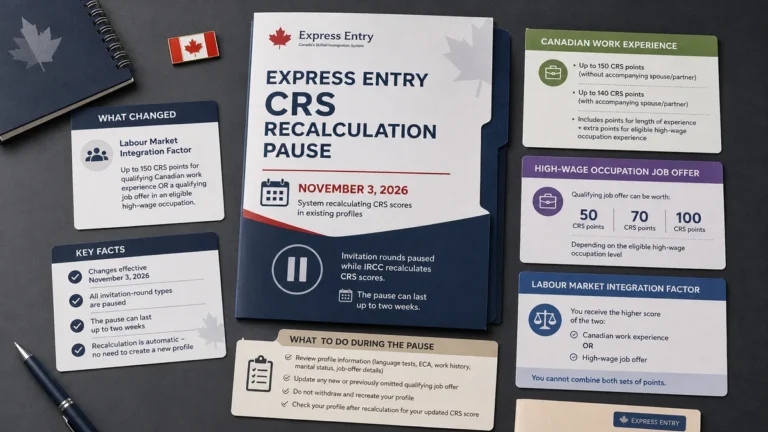
Express Entry Draws Paused for CRS Recalculation

Ontario proposes OSAP rules for private institutions

Start-Up Visa Priority Processing: IRCC’s 3 Tiers

Alberta AAIP Issues 525 Invitations in 6 Rounds

Canada Immigration Announcement on November 12, 2026

Canada’s worker retention measure announced in Budget 2026

Budget 2026 investments highlighted in Thunder Bay