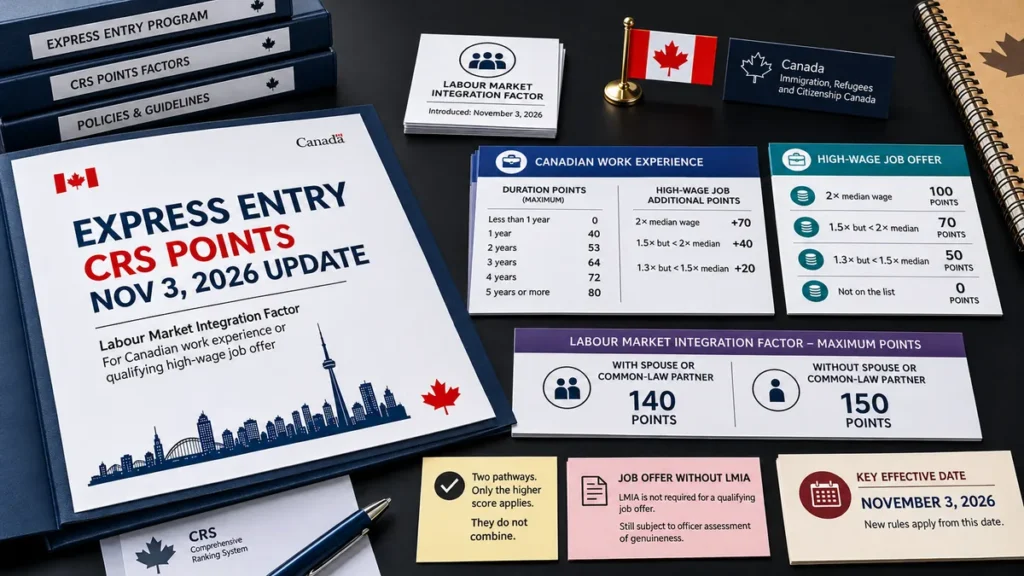
On November 3, 2026, Canada changes how it awards CRS Points Express Entry applicants can earn through Canadian work experience or a qualifying job offer in a high-wage occupation. Under the new Labour Market Integration factor, only the higher of the two scores counts.
What changes on November 3, 2026
The November 3 changes create a new CRS category called the Labour Market Integration factor. It replaces the previous treatment of Canadian work experience within the core human-capital factors and reintroduces CRS points for certain job offers after arranged-employment points were removed in March 2025.
The factor is intended to give greater weight to demonstrated Canadian labour-market attachment. It does this through two possible scoring routes: qualifying Canadian work experience, including additional points where that experience was in a listed high-wage occupation; or a qualifying job offer in a listed high-wage occupation.
This is not a system in which the two routes can be added together. IRCC will calculate the points available from qualifying Canadian work experience and compare them with the points available from a qualifying job offer. The candidate receives the higher result only.
IRCC says profiles already in the Express Entry pool will be recalculated when the changes take effect. That recalculation may take up to two weeks, and invitation rounds will be paused during that period before resuming after recalculation is complete. The pause is operational timing, not a guarantee that every recalculated score will result in an invitation.
- Effective date: November 3, 2026.
- New factor: Labour Market Integration.
- Two alternative routes: Canadian work experience or a qualifying high-wage job offer.
- No stacking: Canadian work experience points and job-offer points under this factor cannot be combined.
- Maximum through Canadian work experience: 150 points without an accompanying spouse or common-law partner, or 140 points with one.
- Maximum through a qualifying job offer: 100 points, whether or not the candidate has an accompanying spouse or common-law partner.
How the Labour Market Integration factor works
A high-wage occupation is determined by the median wage for the occupation’s National Occupational Classification code, not by the salary that a particular candidate earns or has been offered. IRCC defines a high-wage occupation as one whose median wage is at least 1.3 times the average median wage of the overall Canadian workforce.
IRCC assigns occupations to three wage levels: at least twice the average median wage; at least 1.5 times but less than twice; and at least 1.3 times but less than 1.5 times. The first official list takes effect November 3, 2026 and is based on Job Bank, Labour Force Survey and Census of Population data from 2023 to 2025.
For each NOC, IRCC uses the highest wage level that the occupation met in any of the three years examined. If the high-wage occupation list changes after an Invitation to Apply is issued, IRCC says it will continue to use the occupation’s level as it stood on the invitation date.
- Canadian work experience route, with spouse or partner: up to 70 work-length points plus up to 70 high-wage occupation points, for a maximum of 140.
- Canadian work experience route, without spouse or partner: up to 80 work-length points plus up to 70 high-wage occupation points, for a maximum of 150.
- Qualifying high-wage job-offer route: 50, 70 or 100 points, depending on the occupation’s wage level.
- Example: a candidate with five years of eligible Canadian work experience and at least 12 months in a twice-median-wage NOC could receive 150 points without an accompanying spouse or partner: 80 work-length points plus 70 high-wage occupation points.
- Example: a candidate with a qualifying job offer in a 1.5-to-less-than-two-times-median-wage NOC could receive 70 Labour Market Integration points, even if they also have qualifying Canadian work experience. IRCC would award only the higher of the two available route scores.
Canadian work experience: points and hour calculations
The work-length portion of Canadian work experience scoring remains the same as before. Candidates with an accompanying spouse or common-law partner receive 35 points for one year, 46 for two years, 56 for three years, 63 for four years and 70 for five years or more. Candidates without an accompanying spouse or partner receive 40, 53, 64, 72 and 80 points at those same experience levels.
The new high-wage occupation supplement is separate from work length. A candidate needs at least 12 months, or 1,560 hours, of qualifying Canadian work experience in one or more eligible high-wage occupations. Experience can be continuous or non-continuous, full-time or the equivalent amount of part-time work, and can be combined across more than one eligible high-wage occupation.
Hours worked in overlapping jobs do not accelerate the calculation. When a candidate works more than one job at the same time, IRCC counts hours only up to the full-time equivalent of 30 hours per week. In practical terms, working 60 hours in two qualifying jobs in a week does not create two weeks of Canadian work experience.
The existing eligibility rules for Canadian work experience remain important. The work generally must have been acquired in Canada during the preceding 10 years, be paid through wages or commission, and be in NOC TEER 0, 1, 2 or 3. Certain physicians providing publicly funded medical services have specific provisions. Candidates must also have performed the NOC lead statement and a substantial number of the main duties, including all essential duties.
Periods of unauthorized work, self-employment and work performed while the candidate was engaged in full-time study are not counted for this CRS Canadian work experience calculation. Full-time work means at least 30 hours per week, and part-time work is converted using a 30-hour-per-week full-time equivalent.
- Work-length points with spouse or partner: less than one year 0; one year 35; two years 46; three years 56; four years 63; five years or more 70.
- Work-length points without spouse or partner: less than one year 0; one year 40; two years 53; three years 64; four years 72; five years or more 80.
- High-wage experience supplement: at least 12 months in occupations at least twice the average median wage earns 70 points.
- If not eligible for 70 points: at least 12 months combined in occupations at least 1.5 times the average median wage earns 40 points.
- If not eligible for 40 or 70 points: at least 12 months combined in occupations at least 1.3 times the average median wage earns 20 points.
- Less than 12 months of qualifying experience in high-wage occupations earns no high-wage occupation supplement.
- The existing skills-transferability rules do not change. IRCC will continue to assess Canadian work experience for skill-transferability factors under existing duration requirements, without applying the high-wage occupation supplement rules.
Valid job offers and the LMIA change
From November 3, 2026, a Labour Market Impact Assessment is no longer required for a job offer to qualify for Express Entry program eligibility or for the new CRS job-offer points. Having an LMIA will not provide extra CRS points or priority over a comparable qualifying offer without an LMIA.
For CRS job-offer points, the offer must be valid under Express Entry and be for a position in an eligible high-wage occupation. The points depend on the occupation’s official high-wage level: 100 points for a NOC at least twice the average median wage, 70 points for a NOC at least 1.5 times but less than twice the average median wage, and 50 points for a NOC at least 1.3 times but less than 1.5 times the average median wage.
A qualifying offer must generally be for full-time, continuous work in Canada for at least one year after the candidate becomes a permanent resident. IRCC notes that specific rules apply to some occupations, including skilled trades and physicians providing publicly funded medical services.
Removing the LMIA requirement does not mean that IRCC accepts an offer without scrutiny. At the permanent residence application stage, an officer must be satisfied that the offer is genuine. This includes assessing whether the employer is actively operating, can meet the terms of the offer, has a reasonable business need for the position and follows applicable employment and recruitment laws. IRCC will also assess whether the candidate is qualified and able to do the work and is likely to accept and carry out the employment.
The CRS job-offer rules and the program-eligibility rules are not identical. A valid offer can still help a Federal Skilled Worker Program or Federal Skilled Trades Program candidate meet program eligibility even if the occupation is not on the high-wage list. However, an offer outside the high-wage list receives zero Labour Market Integration job-offer points.
IRCC has stated that, while its requirements change on November 3, its online profile system will not yet fully reflect the change. Candidates entering a qualifying offer without an LMIA are instructed to select that a positive LMIA was issued and enter IRCC’s temporary placeholder details: LMIA number 00000, issuance date January 1, 2026 and expiry date January 1, 2029. This is an interim system instruction, not evidence that an actual LMIA exists.
- High-wage job-offer points: twice the average median wage or more, 100 points.
- High-wage job-offer points: at least 1.5 times but less than twice the average median wage, 70 points.
- High-wage job-offer points: at least 1.3 times but less than 1.5 times the average median wage, 50 points.
- A non-high-wage occupation receives 0 job-offer points under the Labour Market Integration factor.
- An LMIA is no longer required for the new CRS job-offer points or qualifying job offers used for relevant program eligibility after the effective date, subject to the applicable public-policy conditions.
- A genuine-offer assessment remains mandatory; the LMIA change does not remove IRCC’s authority to refuse unsupported, non-genuine or misrepresented job offers.
High-wage occupations: at least twice the median
The following official NOC 2021 occupations are in the highest high-wage level, meaning the NOC median wage is at least twice the average median wage of the overall Canadian workforce. A qualifying job offer in one of these occupations can be worth 100 points. At least 12 months of qualifying Canadian work experience in one or more of these occupations can produce the 70-point high-wage experience supplement.
- 00011 — Senior government managers and officials; 00012 — Senior managers – financial, communications and other business services; 00013 — Senior managers – health, education, social and community services and membership organizations.
- 10010 — Financial managers; 10011 — Human resources managers; 10012 — Purchasing managers; 10020 — Insurance, real estate and financial brokerage managers; 10021 — Banking, credit and other investment managers.
- 20010 — Engineering managers; 20011 — Architecture and science managers; 20012 — Computer and information systems managers.
- 21330 — Mining engineers; 21332 — Petroleum engineers.
- 31100 — Specialists in clinical and laboratory medicine; 31101 — Specialists in surgery; 31102 — General practitioners and family physicians; 31103 — Veterinarians.
- 31302 — Nurse practitioners; 31303 — Physician assistants, midwives and allied health professionals.
- 40010 — Government managers – health and social policy development and program administration; 40011 — Government managers – economic analysis, policy development and program administration; 40012 — Government managers – education policy development and program administration; 40019 — Other managers in public administration.
- 40040 — Commissioned police officers and related occupations in public protection services; 40041 — Fire chiefs and senior firefighting officers.
- 41100 — Judges; 41101 — Lawyers and Quebec notaries; 41200 — University professors and lecturers.
- 60010 — Corporate sales managers; 80010 — Managers in natural resources production and fishing; 90011 — Utilities managers.
- Examples: general practitioners and family physicians, software and information-systems executives, financial managers and mining engineers are all in this highest official wage level. The level follows the NOC’s median wage classification, not an individual’s personal earnings.
High-wage occupations: 1.5 to less than twice
The following official NOC 2021 occupations have median wages of at least 1.5 times but less than twice the overall average median wage. A qualifying job offer in these occupations can be worth 70 CRS points. For Canadian work experience, at least 12 months combined in one or more occupations at this level or the highest level can produce a 40-point supplement, unless the candidate qualifies for the higher 70-point supplement.
- 00014 — Senior managers – trade, broadcasting and other services; 00015 — Senior managers – construction, transportation, production and utilities; 10019 — Other administrative services managers; 10022 — Advertising, marketing and public relations managers; 10029 — Other business services managers; 10030 — Telecommunication carriers managers.
- 11103 — Securities agents, investment dealers and brokers; 11201 — Professional occupations in business management consulting.
- 21100 — Physicists and astronomers; 21102 — Geoscientists and oceanographers; 21103 — Meteorologists and climatologists; 21109 — Other professional occupations in physical sciences; 21111 — Forestry professionals; 21120 — Public and environmental health and safety professionals.
- 21202 — Urban and land use planners; 21210 — Mathematicians, statisticians and actuaries; 21211 — Data scientists; 21220 — Cybersecurity specialists; 21221 — Business systems specialists; 21222 — Information systems specialists; 21223 — Database analysts and data administrators; 21230 — Computer systems developers and programmers; 21231 — Software engineers and designers; 21232 — Software developers and programmers.
- 21300 — Civil engineers; 21301 — Mechanical engineers; 21310 — Electrical and electronics engineers; 21311 — Computer engineers, except software engineers and designers; 21320 — Chemical engineers; 21321 — Industrial and manufacturing engineers; 21322 — Metallurgical and materials engineers; 21331 — Geological engineers; 21390 — Aerospace engineers; 21399 — Other professional engineers.
- 22231 — Engineering inspectors and regulatory officers; 22312 — Industrial instrument technicians and mechanics.
- 30010 — Managers in health care; 31110 — Dentists; 31112 — Audiologists and speech-language pathologists; 31120 — Pharmacists; 31200 — Psychologists; 31202 — Physiotherapists; 31203 — Occupational therapists; 31300 — Nursing coordinators and supervisors; 31301 — Registered nurses and registered psychiatric nurses; 32111 — Dental hygienists and dental therapists.
- 40020 — Administrators – post-secondary education and vocational training; 40021 — School principals and administrators of elementary and secondary education; 40030 — Managers in social, community and correctional services; 40042 — Commissioned officers of the Canadian Armed Forces.
- 41210 — College and other vocational instructors; 41220 — Secondary school teachers; 41221 — Elementary school and kindergarten teachers; 41310 — Police investigators and other investigative occupations; 41311 — Probation and parole officers; 41320 — Educational counsellors.
- 41401 — Economists and economic policy researchers and analysts; 41402 — Business development officers and market researchers and analysts; 41404 — Health policy researchers, consultants and program officers; 41407 — Program officers unique to government.
- 42100 — Police officers, except commissioned; 42101 — Firefighters; 50010 — Library, archive, museum and art gallery managers; 50011 — Managers – publishing, motion pictures, broadcasting and performing arts; 51100 — Librarians.
- 70010 — Construction managers; 70012 — Facility operation and maintenance managers; 70020 — Managers in transportation; 70021 — Postal and courier services managers.
- 72011 — Contractors and supervisors, electrical trades and telecommunications occupations; 72012 — Contractors and supervisors, pipefitting trades; 72023 — Supervisors, railway transport operations; 72103 — Boilermakers; 72202 — Power system electricians; 72203 — Electrical power line and cable workers; 72301 — Steamfitters, pipefitters and sprinkler system installers; 72406 — Elevator constructors and mechanics.
- 72600 — Air pilots, flight engineers and flying instructors; 72601 — Air traffic controllers and related occupations; 72604 — Railway traffic controllers and marine traffic regulators; 73310 — Railway and yard locomotive engineers.
- 82020 — Supervisors, mining and quarrying; 82021 — Contractors and supervisors, oil and gas drilling and services; 83101 — Oil and gas well drillers, servicers, testers and related workers.
- 90010 — Manufacturing managers; 92011 — Supervisors, petroleum, gas and chemical processing and utilities; 92100 — Power engineers and power systems operators; 93100 — Central control and process operators, mineral and metal processing; 93101 — Central control and process operators, petroleum, gas and chemical processing.
- Examples: registered nurses, data scientists, software engineers and designers, civil engineers, electricians in listed supervisory occupations, construction managers and pharmacists are in this wage level.
High-wage occupations: 1.3 to less than 1.5 times
The following official NOC 2021 occupations have median wages of at least 1.3 times but less than 1.5 times the overall average median wage. A qualifying job offer in these occupations can be worth 50 CRS points. At least 12 months of qualifying Canadian work experience combined across occupations at this level or a higher level can produce a 20-point high-wage experience supplement where the candidate does not qualify for the 40- or 70-point supplement.
- 00010 — Legislators.
- 11100 — Financial auditors and accountants; 11101 — Financial and investment analysts; 11102 — Financial advisors; 11109 — Other financial officers; 11200 — Human resources professionals; 12201 — Insurance adjusters and claims examiners; 12203 — Assessors, business valuators and appraisers.
- 21101 — Chemists; 21110 — Biologists and related scientists; 21112 — Agricultural representatives, consultants and specialists.
- 21200 — Architects; 21201 — Landscape architects; 21203 — Land surveyors; 21234 — Web developers and programmers.
- 22214 — Technical occupations in geomatics and meteorology; 22232 — Occupational health and safety specialists; 22233 — Construction inspectors; 22310 — Electrical and electronics engineering technologists and technicians; 22313 — Aircraft instrument, electrical and avionics mechanics, technicians and inspectors.
- 31121 — Dietitians and nutritionists; 32102 — Paramedical occupations; 32103 — Respiratory therapists, clinical perfusionists and cardiopulmonary technologists; 32120 — Medical laboratory technologists; 32121 — Medical radiation technologists; 32122 — Medical sonographers.
- 41300 — Social workers; 41400 — Natural and applied science policy researchers, consultants and program officers; 41403 — Social policy researchers, consultants and program officers; 41405 — Education policy researchers, consultants and program officers; 41409 — Other professional occupations in social science.
- 43201 — Correctional service officers; 43203 — Border services, customs, and immigration officers.
- 50012 — Recreation, sports and fitness program and service directors; 51101 — Conservators and curators; 51102 — Archivists; 51111 — Authors and writers, except technical; 51112 — Technical writers; 51120 — Producers, directors, choreographers and related occupations; 52112 — Broadcast technicians.
- 60020 — Retail and wholesale trade managers; 60031 — Accommodation service managers; 60040 — Managers in customer and personal services.
- 72010 — Contractors and supervisors, machining, metal forming, shaping and erecting trades and related occupations; 72013 — Contractors and supervisors, carpentry trades; 72014 — Contractors and supervisors, other construction trades, installers, repairers and servicers; 72020 — Contractors and supervisors, mechanic trades; 72021 — Contractors and supervisors, heavy equipment operator crews.
- 72102 — Sheet metal workers; 72105 — Ironworkers; 72201 — Industrial electricians; 72302 — Gas fitters; 72320 — Bricklayers; 72321 — Insulators; 72401 — Heavy-duty equipment mechanics; 72403 — Railway carmen/women; 72404 — Aircraft mechanics and aircraft inspectors; 72500 — Crane operators.
- 72602 — Deck officers, water transport; 72603 — Engineer officers, water transport; 73311 — Railway conductors and brakemen/women.
- 82010 — Supervisors, logging and forestry; 83100 — Underground production and development miners; 83120 — Fishing masters and officers; 92010 — Supervisors, mineral and metal processing; 93102 — Pulping, papermaking and coating control operators.
- Examples: financial auditors and accountants, human resources professionals, architects, web developers and programmers, social workers, industrial electricians, crane operators and heavy-duty equipment mechanics are in this wage level.
Practical implications for Express Entry candidates
Candidates should first identify the correct five-digit NOC based on the work actually performed rather than a job title alone. A listed NOC does not help if the candidate cannot show that they performed the lead statement and the required duties for that NOC. The same care is important for job offers, because IRCC will assess whether the position, employer and candidate relationship are genuine.
Candidates with Canadian work experience should calculate two separate elements: their work-length points and, if applicable, their high-wage occupation supplement. A candidate with one year of qualifying Canadian experience in an eligible high-wage NOC may receive both the work-length score and the appropriate high-wage supplement. Conversely, Canadian experience in a TEER 0 to 3 occupation that is not on the high-wage list can still receive work-length points but no high-wage supplement.
Candidates considering a job-offer claim should not assume that any skilled job offer produces CRS points. For the new Labour Market Integration factor, the occupation itself must appear on the official high-wage list. A job offer in another eligible TEER 0 to 3 occupation may still be relevant to Federal Skilled Worker Program or Federal Skilled Trades Program eligibility, but it does not receive the new CRS job-offer points.
Because IRCC will use the higher of the Canadian-work-experience route and the job-offer route, candidates should compare the routes rather than adding them. For example, five years of qualifying Canadian work experience plus the 70-point highest wage supplement produces more points than any qualifying job offer. By contrast, a candidate with limited or no qualifying Canadian work experience may benefit more from a genuine qualifying job offer in an occupation at the highest wage level.
Finally, additional CRS points do not guarantee an Invitation to Apply. Invitations continue to depend on the type of round, the number of invitations issued and the CRS cut-off established for that round. Candidates should update profile information accurately and retain evidence supporting work history, NOC duties and any claimed job offer.
- Use the NOC that matches the actual duties performed, not simply the employer’s preferred title.
- Confirm that Canadian work experience is paid, authorized, within the relevant 10-year period and in an eligible NOC or physician category.
- Do not double-count simultaneous work above 30 hours per week when calculating the 1,560-hour threshold.
- Treat the high-wage occupation list as a separate test from TEER eligibility.
- For a job-offer claim, be prepared to demonstrate that the employer is active, has a reasonable need for the role, can meet the offer terms and is complying with employment and recruitment laws.
- For candidates invited on or after November 3, 2026, assess the temporary LMIA public policy and the program-specific requirements that apply to the invitation and application.
Source: 2026 changes to points for Canadian work experience and job offers in the Express Entry system
Disclaimer
Maplevisa provides Canadian immigration news and information for general informational purposes only. Content is not legal or immigration advice and should not be relied upon as a substitute for advice based on your individual circumstances. Immigration laws, policies, programs, and procedures may change. Where applicable, readers should consult the relevant official government or legal source for current information.
More Immigration News

Haiti Open Work Permit Renewals Policy
Sudan Open Work Permit Renewal Policy in Canada

Canada Immigration Processing Times on 1 November 2026

BC PNP Skills Draw Issues 772 ITAs on October 29, 2026

IRCC Changes LMIA Concurrent Processing
Express Entry Draw 453 Transport on October 28, 2026
Express Entry Draw 452 French-Language on October 27, 2026
Express Entry Draw 451 PNP on October 26, 2026

Alberta AAIP draws: five rounds, October 9–20, 2026