The Job Bank wage update 2026 is scheduled for November 18. Employment and Social Development Canada (ESDC) identifies the date in its high-wage Temporary Foreign Worker Program requirements. Employers should prepare for the annual prevailing-wage review, rather than assume every occupation will receive the same increase.

Job Bank wage update 2026 and the review deadline
For the fall 2026 update, the annual review is due by January 1, 2027. Employers must also reassess the prevailing wage when a temporary foreign worker starts employment. A positive Labour Market Impact Assessment (LMIA) does not remove that ongoing obligation.
The November notice supplies a publication date, not a universal new hourly rate. Occupation-specific amounts must be checked when available.
Which wage must an employer pay?
The prevailing wage is the higher of the relevant Job Bank median or the wage within the range paid to comparable existing employees. The comparison concerns the same job and work location, with similar skills and experience; selecting the lowest published figure is not the rule.
The updated wage must not fall below the amount in the positive LMIA during the worker’s employment, even if the prevailing wage falls. This is why an annual review is a comparison of obligations, not permission to reset pay automatically to the latest median.
How to identify the relevant Job Bank figure
Search using the job title or the National Occupational Classification (NOC) code that matches the actual duties. Confirm the community or economic area and distinguish the median from the low and high estimates. If the local median is unavailable, the high-wage requirements direct employers to the provincial or territorial figure, then the national figure if necessary.
Job Bank’s methodology selects the best available data for an occupation and region. Its published figures describe a typical worker; they do not individually account for the experience of the person being hired.
Job Bank wages and high-wage stream thresholds differ
The occupation-specific prevailing wage is not the same as the provincial or territorial threshold used to classify an LMIA application as high-wage or low-wage. ESDC publishes that threshold separately, using the provincial or territorial median hourly wage plus 20%.
For a new application, an offered wage at or above the applicable threshold falls under the high-wage stream; an amount below it falls under the low-wage stream. Offering a higher amount solely to fit a stream does not replace the requirement for a wage comparable to the actual job. The November Job Bank notice should not be treated as an announcement that every stream threshold changes that day.
What the updated figures can tell employers
Job Bank wages use a joint ESDC and Statistics Canada methodology. The estimates draw on available statistical and administrative sources, rather than representing a single employer’s offer or a live quotation for every vacancy.
There is a delay between collecting data and publishing it. Reference periods can differ between sources, and the year shown for an update does not mean all underlying wages were earned in that calendar year.
Comparing the correct occupation and region is therefore more useful than treating a headline percentage or a national average as the required wage for a particular position.
When a wage change needs to be reported
ESDC’s high-wage guidance says a wage modification that meets the prevailing wage does not need to be reported to Service Canada. That statement should be read with the separate rules on modifications to a positive LMIA, rather than as a blanket exemption for every change to employment.
Those rules distinguish minor and material modifications. A different occupation or employer, changes in hours or benefits, and wage changes outside the permitted conditions may require action. The employer remains responsible for determining the appropriate response.
Where necessary, use ESDC’s modification guidance and Employer Contact Centre rather than assuming that the original approval authorizes a revised arrangement.
A practical wage-review checklist
A useful review file connects the published benchmark to the worker’s actual employment terms. Employers preparing for the update can organize the review as follows:
- Identify each affected worker’s occupation, work location, LMIA wage and current pay before comparing the new information.
- Save the relevant Job Bank result and its date, together with the basis for comparing wages paid to existing employees.
- Record the review decision and, where an adjustment is required, keep the updated employment and payroll documentation consistent.
- Check separately whether a related change to duties, employer, hours or benefits requires reporting or a new LMIA.
- Keep the supporting material accessible with the LMIA decision letter, annexes and employment records.
Why the review record matters
ESDC requires relevant employment and LMIA records to be retained for six years from the first day of the employment period for which the work permit was issued. Inspectors can examine whether wages and working conditions meet the employer’s obligations.
Non-compliance can lead to warnings, monetary penalties, bans or action affecting an LMIA. Completing a documented review helps an employer explain what was checked and corrected; it does not guarantee that every other program requirement has been met.
Maplevisa provides Canadian immigration news and information for general informational purposes only. Content is not legal or immigration advice and should not be relied upon as a substitute for advice based on your individual circumstances. Immigration laws, policies, programs, and procedures may change. Where applicable, readers should consult the relevant official government or legal source for current information.
Disclaimer
Maplevisa provides Canadian immigration news and information for general informational purposes only. Content is not legal or immigration advice and should not be relied upon as a substitute for advice based on your individual circumstances. Immigration laws, policies, programs, and procedures may change. Where applicable, readers should consult the relevant official government or legal source for current information.
More Immigration News
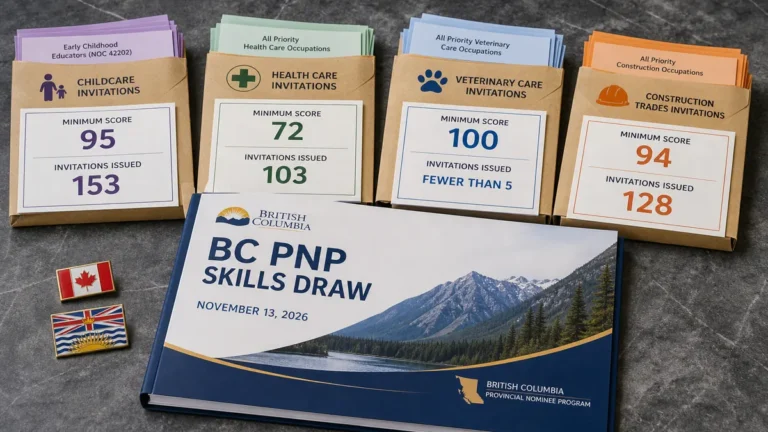
BC PNP Draw November 13, 2026: 384+ Invitations Issued

Newfoundland and Labrador Issues 38 NLPNP & AIP Invitations
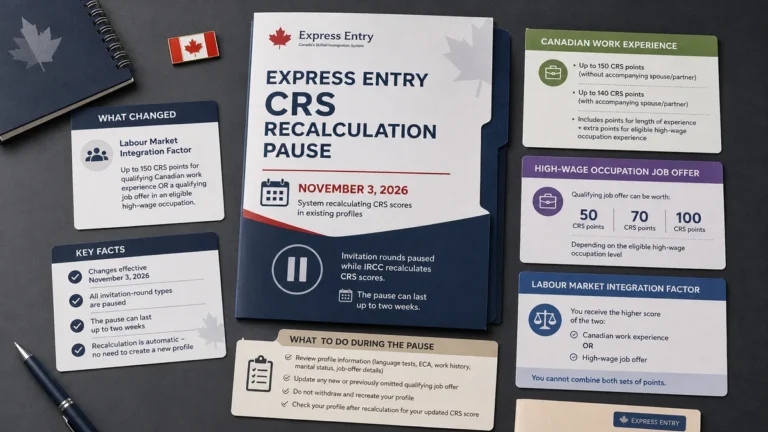
Express Entry Draws Paused for CRS Recalculation
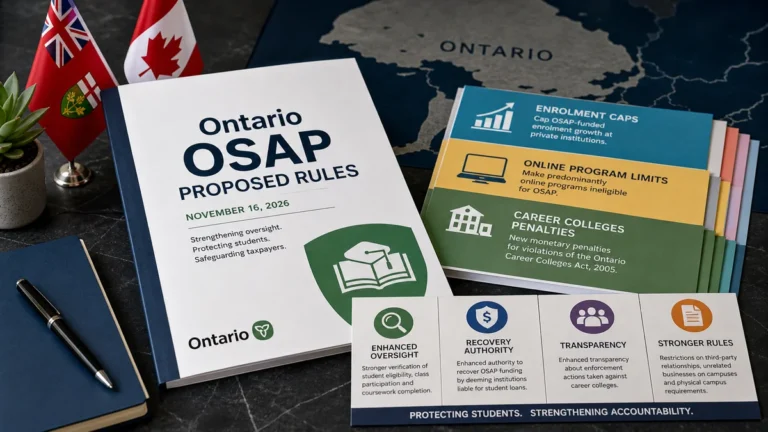
Ontario proposes OSAP rules for private institutions

Start-Up Visa Priority Processing: IRCC’s 3 Tiers

Alberta AAIP Issues 525 Invitations in 6 Rounds
Canada Immigration Announcement on November 12, 2026

Canada’s worker retention measure announced in Budget 2026
Budget 2026 investments highlighted in Thunder Bay